Implementation of the Animal Health Law: challenges and perspectives
Partager la page
The Analysis notes present, in four pages, the main reflections on a current topic falling within the remit of the Ministry of Agriculture, Agrifood and Food Sovereignty. Depending on the issue, they favour a forward-looking, strategic or evaluative approach.
Implementation of the Animal Health Law: challenges and perspectives
The 2016 Animal Health Law (AHL) and its implementation in French law from 2021 change the categorisation of 'regulated diseases' and the measures for prevention, surveillance and control on farms. In this context, the Ministry of Agriculture, Agrifood and Food Sovereignty (MAASA) commissioned a study to assess its consequences, particularly in terms of the responsibilities of livestock professionals and funding1. This Analysis describes the expected impacts of the AHL and how these are perceived by stakeholders in the industry. It shows that the law scarcely affects the overall cost of managing regulated diseases, but that it leads to a redefinition of the actors' responsibilities and clarifies commitments in terms of funding. It also proposes improvements to data management in order to obtain a clearer view of the costs associated with these diseases.
Introduction
Regulation (EU) 2016/4292, known as the 'Animal Health Law' (AHL), aims to harmonise the management of animal health in the European Union (EU). It changes the management of so-called 'regulated' animal diseases. These diseases generally have high contagiousness (epizootics), are transmissible to humans (zoonoses) or have a high potential for economic repercussions. The three can be associated. Their management is based on several types of actions: prevention, surveillance, and control measures in the event of confirmed disease.
The transposition of the European regulation into French law and its implementation change the system in force until 2021, in which the Rural and Maritime Fishing Code (Code rural et de la pêche maritime, CRPM) classified diseases according to the responsibility of the actors. The AHL introduces a new classification based on hazard levels. It emphasises the prevention and control of zoonoses, traceability of animals, border controls and biosecurity on farms. It relies more on the notion of risk management and strengthens the responsibilities of professionals in the livestock sectors.
In this context, the MAASA commissioned the National Veterinary School of Toulouse to conduct a study with the objectives of taking stock of the sanitary management of regulated animal diseases in France, specifying the funding conditions for this management, analysing the potential impacts of the AHL and indicating how it is perceived by stakeholders in these sectors.
The first part of this note presents the changes induced by the application of the AHL in terms of disease classification and stakeholder responsibility. The concerns of the latter regarding the law are then presented. Finally, the third part analyses the future impacts of the AHL on the funding circuits for the management of regulated diseases and on human resource needs.
Changes brought about by the AHL for the management of veterinary public health
In France, the governance of veterinary public health is shared between public and private actors, who carry out missions of prevention, surveillance and control of regulated diseases, and ensure their funding with or without public aid. The AHL changes the responsibilities assigned to these various actors. It emphasises prevention and introduces a new classification of diseases.
The new classification changes intervention levels for certain diseases
Until October 20th, 2021, the CRPM classified diseases into three 'sanitary hazard' categories (DS1, DS2 and DS3), according to the level of danger and the entity responsible for organising surveillance and control (the State, professionals and farmers respectively), among other criteria.
The AHL and the ordinance aligning French law with the European regulation3 now distinguish five categories according to the level of intervention required: (A) diseases absent from the national territory requiring immediate eradication, (B) diseases requiring compulsory eradication, (C) diseases requiring voluntary eradication, (D) diseases leading to movement restrictions, (E) diseases subject to surveillance (table 1). These categories are cumulative and involve different management measures. Sixty-three diseases are concerned, ten of which are newly regulated (dourine in horses, paratuberculosis, Q fever, etc.). Conversely, other diseases now fall outside the scope of European regulations. Sixteen diseases said 'of national interest' remain regulated in France4 (e.g. botulism, bovine hypodermosis, moderately virulent porcine epidemic diarrhoea), permanently or temporarily, while five diseases formerly regulated no longer are (sheep scab, Ebola, visna-maëdi, Batrachochytrium salamandrivorans, echinococcosis).
Table 1 – Correspondence between sanitary hazards and diseases A, B, C, D and E
| French categorisation | AHL categorisation |
|---|---|
| DS1 PISU5 | A, D, E |
| DS1 | B, D, E |
| DS2 regulated | C, D, E |
| DS2 non-regulated or DS3 | DE or E or non listed disease |
Source : authors
All diseases listed are subject to programmed or event-based surveillance, with particular emphasis on prevention. Depending on the disease, the AHL may be more, equally or less restrictive than the previous regulation. For example, the AHL changes the prophylaxis protocols for infectious bovine rhinotracheitis: it strengthens measures for herds that are not disease-free, but eases surveillance for herds that have been disease-free for more than three years. Nevertheless, in France, the vast majority of diseases covered by the previous regulation remains within the scope of the AHL: brucellosis, contagious nodular dermatitis, foot-and-mouth disease, bluetongue, avian influenza, swine fever, rabies, tuberculosis, etc. The operational management of these diseases is only slightly modified.
The AHL changes the terms of exchanges between European countries to facilitate international trade, while ensuring the country's sanitary status. For example, with regard to bluetongue, the AHL replaces the old system of bilateral agreements between countries with an obligation to vaccinate animals at least 60 days before they are moved.
The responsibility of animal holders is strengthened
The AHL holds animal owners or keepers responsible for their health and its surveillance. It requires them to acquire the knowledge necessary for appropriate sanitary management, with the support of veterinarians. Administrative authorities are required to have qualified staff, sufficient resources, and a network of laboratories available to ensure the proper functioning of the surveillance system.
In addition, collective sanitary programmes of general interest (Programmes sanitaires d’intérêt collectif, PSIC) may be drawn up at the initiative of producer organisations or sanitary defence groups to manage collectively the diseases that are no longer covered by a ministerial order6. A PSIC involves the drafting, by professionals in the sector, of a set of specifications for diseases, whether regulated or not, which makes it possible to organise surveillance and control actions in addition to any measures defined by the State. The PSICs are open to all animal keepers concerned in the geographical area concerned. The PSICs are funded by their members and they allow the sanitary management costs to be pooled. However, they do not cover sanitary policing missions, which are reserved for the State.
Finally, the AHL places the emphasis on prevention. It requires operators to carry out risk assessments and any biosecurity measures, for example in poultry7 and pig8 livestock. This risk analysis must identify all risks of introduction, development and spread of animal diseases within an establishment. From this, a biosecurity plan must include, among other things, a plan for the movement of animals, humans, inputs and products and by-products, cleaning-disinfection and pest control protocols, protection against wildlife, and training plans on good hygiene practices. This document can be consulted during an inspection and must be assessed periodically. The AHL also allows the implementation of preventive vaccination strategies, such as the French vaccination plan against highly pathogenic avian influenza9, following the opinion issued by Anses10.
Although these modifications remain limited in practice, the interviews conducted in 202311 showed that stakeholders were concerned, both regarding the distribution of roles and the expenses to be incurred.
The AHL, a partially misunderstood piece of legislation that arouses concerns
Helping farmers towards a better understanding of the new legislative framework
All the actors interviewed in 2023 report a need for clarification of the consequences of the AHL, particularly farmers, who are at the heart of the scheme. As the AHL highlights prevention, they will henceforth be more involved in organising and promoting sanitary measures on their farms. In the future, the management of regulated diseases will increasingly rely on them and on health-related organizations12 who note a lack of practical knowledge and do not feel sufficiently integrated into the information channels. These gaps could be filled by facilitating access to information, for example via an online platform or communication tools. Discussions and concerted action are needed to ensure a shared understanding of the requirements of the AHL and the actions it calls for. Transparent and regular communication between health authorities and stakeholders therefore seems essential in order to help professionals adapt to the new regulatory framework.
The interviewees also highlighted the need to be able to call on experts to obtain the desired information. According to those surveyed, the absence of a designated official to coordinate actions and interpret the regulations is an obstacle to the application of the AHL. They would like, in particular, to be able to contact a reference person who could explain regulatory changes, disease by disease, specify everyone's responsibilities and the arrangements for financing prevention and control actions, etc.
The implementation of the AHL requires substantial efforts in terms of training and communication within government bodies. Staff from the Regional Directorates for Food, Agriculture and Forestry (DRAAF) were specially trained to apply the new regulations and meetings were organised to inform professionals of the changes and the procedures to follow.
These training actions could be extended to farmers to make them aware of the issues of the AHL and encourage them to adopt sanitary practices suited to their needs. In the livestock sectors, it is imperative to encourage the maintenance of adequate surveillance capacities in order to prevent sanitary risks. Two subjects, the early detection of diseases and preventive practices, are particularly critical key points in the new regulation.
Promoting a culture of prevention in the livestock sectors, in terms of both theoretical understanding and technical skills, would enable farmers to contribute proactively to risk management, which would benefit the entire downstream food chain. Indeed, effective upstream prevention reduces the risk of finding a pathogen in livestock products downstream (processing, distribution). As such, downstream actors could be asked to provide financial support for the efforts made by farmers.
What role for veterinarians and departmental laboratories ?
With the modification of the legislative framework, some sanitary actors, and in particular the veterinarians interviewed, fear 'losing their influence and legitimacy in the management of deregulated diseases'13, due to a reduced direct role of the State. The transfer of sanitary responsibility to professionals and the absence of sanitary policing in PSICs seem to pose two major problems. Firstly, veterinary health professionals fear that, in the absence of a ministerial decree and sanitary policing measures, it will be more difficult to compel reluctant farmers to follow sanitary measures (vaccination, blocking the movement of reported animals, etc.). Secondly, although the actors interviewed are generally willing to commit to the new distribution of roles, some fear that economic issues (e.g., maintaining markets, farm productivity) will take precedence over sanitary issues.
In addition, the territorial network of official laboratories has been weakened. Of France's 96 metropolitan departments, 15 no longer have departmental laboratories due to site closures or mergers (figure 1). The remaining structures consider that they are experiencing a 'loss of competent laboratory staff'', weakening their capacity to meet increasing analysis needs. At the scale of a laboratory, the great challenge, according to the people interviewed, would be to 'continue to deliver expert results while maintaining an economic balance that does not weigh too heavily on the département council budget''. These concerns, noted during the survey, were likely to undermine the implementation of the new rapid alert system desired by the AHL. Decree No. 2023-1358 of December 28th, 2023, published since then, addresses this through its objective of maintaining skills in approved laboratories carrying out controls. This text provides a framework for the public service obligations of veterinary laboratories, notably by setting up agreements with the State and financial compensation.via its objective of maintaining skills in the accredited laboratories performing inspections. This text provides a framework for the public service obligations of veterinary laboratories, notably by establishing an agreement with the State and financial compensation.
Figure 1 – Areas without departmental analysis laboratories
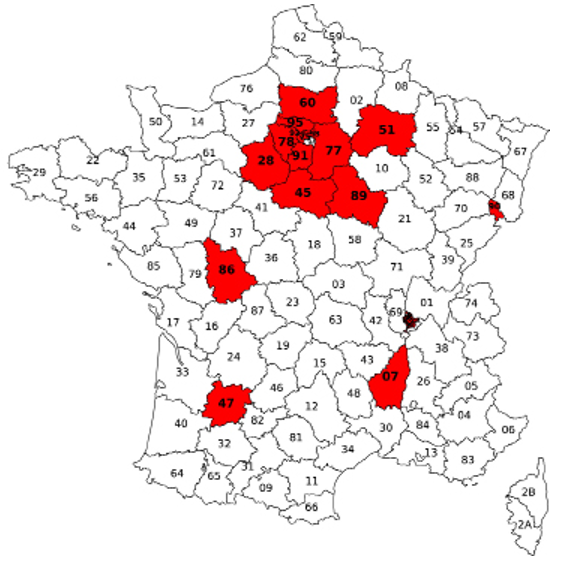
Cette carte représente les départements français sans laboratoires départementaux d’analyses : il y a un manque dans toute l’Ile-de-France et les départements suivants : Eure-et-Loir, Loiret, l’Yonne, Oise, Marne, Territoire de Belfort, Vienne, Lot-et-Garonne et Ardèche.
This map shows the French départements without departmental analysis laboratories: there is an absence across the whole of Île-de-France and the départements of Eure-et-Loir, Loiret, Yonne, Oise, Marne, Territoire de Belfort, Vienne, Lot-et-Garonne and Ardèche.
Some actors worry about a possible disengagement of the State
The change of paradigm brought about by the AHL, where prevention takes precedence over disease control, is likely to modify the deployment of the resources mobilised by the State. Stakeholders are concerned about this and fear the consequences of a redeployment of human resources accompanied by a possible financial disengagement by the State.
A disengagement to be put into perspective
‘The State is disengaging and says: “now it is up to the sectors to take over”’, according to some professionals in the livestock sector. They perceive the application of the AHL as a disengagement by the State, shifting responsibility for funding and responsibilities onto professionals.
The entry into force of the AHL should only slightly modify the total expenditure linked to the management of regulated diseases. Indeed, newly regulated pathologies are mostly exotic diseases that are unlikely to enter the territory and thus to generate new expenditure. Furthermore, the majority of diseases initially classified as DS1, DS2 or DS3 remain regulated (categorised in the AHL or subject to permanent national regulation) and the control measures are maintained. The recent management of contagious bovine nodular dermatitis, classified as category A by the AHL, illustrates this well, including in financial terms: the State fully covers compulsory vaccination in regulated zones, compensates farmers for animals slaughtered by order of the administration, and lengthens the unproductive period of the farm by including the period of prohibition on restocking animals14. In addition, among all the diseases not listed by the AHL, 16 are included in the order of May 3rd 2022 and therefore remain subject to national regulation15.
The AHL only marginally changes the financing scheme for sanitary measures. The level of intervention of the National Agricultural Mutual Fund for Sanitary and Environmental Risks16 (Fonds national Agricole de mutualization sanitaire et environnemental, FMSE) could thus increase, for example for the tuberculosis programme.
It should be noted that the costs of control operations, usually low, can increase drastically in the event of a major epizootic. For example, between the avian influenza epizootics of 2016–2017 and 2021–2022, these costs rose from 160 million euros (M€) to more than one billion euros, including 800 M€ in compensation and 245 M€ allocated to the sanitary component, an increase of 650% (figure 2). This difference is mainly due to the extension of the 2021–2022 epizootic to the broiler and laying poultry sectors (beyond the sole waterfowl sector already affected in 2016–2017) and to the hatching areas. Thus, more than the sanitary component, it is the economic losses and associated compensation that have increased considerably between the two crises. These costs were covered by the State.
Figure 2 – Breakdown of State expenditure, excluding contributions to the National Agricultural Mutual Fund for Sanitary and Environmental Risk (M€)
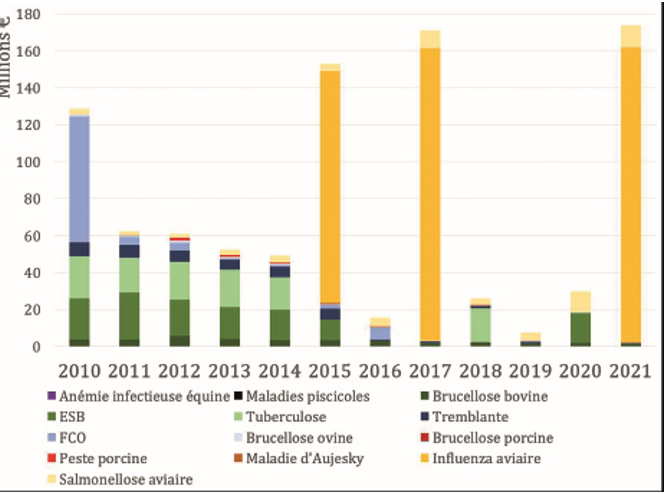
Ce graphique décrit la ventilation par année de 2010 à 2021 et par maladie des dépenses de l’Etat, hors contributions au Fonds national agricole de mutualisation du risque sanitaire et environnemental. Il montre que les coûts des opérations de lutte, habituellement faibles (moins de 60 millions d’euros), peuvent augmenter très fortement en cas d’épizooties majeures, par exemple en 2010 avec la fièvre catarrhale ovine ou en 2015, 2017 et 2021 avec les crises d’influenza aviaire.
This graph shows the breakdown by year from 2010 to 2021 and by disease of State expenditure, excluding contributions to the national agricultural mutual risk fund. It shows that the costs of control operations, usually low (less than 60 million euros), can rise very sharply in the event of major epizootics, for example in 2010 with bluetongue or in 2015, 2017 and 2021 with the avian influenza crises.
Source: authors, based on data from the Bulletin épidémiologique de l’Anses and from the Rapport d’information n° 1069 from the Assemblée nationale
For diseases not categorised by the AHL or subject to temporary national regulation under the order of May 3rd, 2022, sectors are encouraged to anticipate organisational changes and the transfer of control responsibilities from the State to professionals by establishing PSICs. Within a PSIC, professionals are responsible for managing and financing surveillance missions, including event-based surveillance, which previously, most of the time, fell under State responsibility.
A human resource cost that is difficult to estimate
Estimating the costs caused by animal diseases is difficult. They vary depending on the specific activities of each sector and how they are organised. In addition, internal assessments carried out by the administration or sectors are not always published, making it difficult to obtain reliable data. This shortfall hampers the estimation of the total funding required for the management of animal diseases in France, and creates an obstacle to developing effective strategies to prevent and control them. It therefore seems important to step up efforts to publish, collect, and share data on the costs of managing regulated diseases. The AHL offers a valuable opportunity to do so.
Estimating human resource costs is particularly difficult. Indeed, the working time of civil servants assigned to sanitary services is never taken into account in economic assessments, whereas this tally is carried out in the private sector. An assessment of this working time devoted to sanitary management would allow a more accurate evaluation of the public authority's investment in the prevention, control and surveillance of animal diseases.
Strengthening veterinary staff is an issue in the prevention of epidemics and in maintaining public health, with private and public veterinarians ensuring sanitary surveillance and the transmission of important information. This is an especially important issue since the AHL is based on making livestock professionals responsible, of whom veterinarians are the preferred contacts. The decline of the network of rural veterinarians and the lack of generational renewal are challenges affecting all sectors. This limits the availability and responsiveness of veterinarians and increases intervention costs due to travel expenses.
Maintaining an adequate workforce (veterinarians and public officers) is therefore essential. For the veterinary profession, a plan to defend the territorial network has been underway for several years. In addition, spending on training and maintaining the skills of analysis laboratory staff is often neglected, despite its importance in ensuring the continuous and efficient operation of laboratories.
Conclusion
The AHL promotes sanitary surveillance based on greater involvement of livestock professionals, notably by transferring to them the responsibility for carrying out certain sanitary control measures. This change of approach leads to distrust among some professionals, who perceive the AHL as a withdrawal by the State, both in terms of funding and in the exercise of responsibilities.
This study shows that the AHL scarcely reduces the scope of State intervention in sanitary management. Moreover, it does not significantly affect the overall cost of sanitary management of regulated diseases. On the other hand, via the new classification of diseases and the creation of PSICs, the AHL leads to a redefinition of the distribution of stakeholders' missions and their commitment to funding sanitary measures. Although the State is not the driving force behind the creation of PSICs, the forthcoming formalisation of a framework by the ministry in charge of agriculture should facilitate and make their implementation more effective by playing a 'quality assurance' role upstream and by initiating new national or regional sanitary policies. The current and expected increase in animal diseases, which have serious sanitary and economic consequences, gives this law and its implementation in the field particular importance.
The Animal Health Conference (Assises du sanitaire animal), whose work was launched on January 30th, 2025, aims to provide answers to the various concerns that the study has helped to bring to light. Bringing together all the actors involved in the field of animal health, this conference aims to consolidate the mechanisms within the renewed AHL framework. Their conclusions are announced for the end of the first half of 2026. The overhaul of the French sanitary model is also continuing via the ongoing work of the food sovereignty conferences, which are expected to pay particular attention to emerging epizootics.
Guillaume Lhermie, Lisa Vors, Lucie Guinaliu Buttarelli
National Veterinary School of Toulouse
Franck Bourdy
Centre for studies and strategic foresight
Footnotes
1 - Lhermie G. et al., 2024, Évaluation des coûts des maladies réglementées et de l’impact de la loi de santé animale, rapport pour le ministère de l’Agriculture, de la Souveraineté alimentaire et de la Forêt.
2 - Regulation (EU) 2016/429 of the european parliament and of the council of 9 March 2016 on transmissible animal diseases and amending and repealing certain acts in the area of animal health
3 - Ordonnance n° 2021-1370 du 20 octobre 2021 relative aux mesures de surveillance, de prévention et de lutte contre les maladies animales transmissibles.
5 - Some DS1 are covered by a National Health Emergency Intervention Plan (PISU), which 'defines the organisational principles and the resources to be mobilised to deal with these sanitary hazards and provides for the measures to be implemented in the event of suspicion or confirmation of an outbreak' (Art L.201-5 CRPM)
6 - At the time of writing this note, the regulatory provisions for the application of these programmes are still awaiting publication at national level.
7 - Arrêté du 29 septembre 2021 relatif aux mesures de biosécurité applicables par les opérateurs et les professionnels liés aux animaux dans les établissements détenant des volailles ou des oiseaux captifs, dans le cadre de la prévention des maladies animales transmissibles aux animaux ou aux êtres humains.
8 - Arrêté du 16 octobre 2018 relatif aux mesures de biosécurité applicables dans les exploitations détenant des suidés dans le cadre de la prévention de la peste porcine africaine et des autres dangers sanitaires réglementés.
9 - Ministère de l’agriculture et de la souveraineté alimentaire, 2024, Influenza aviaire : le plan de vaccination de la France.
10 - Anses, 2023, Avis relatif à l’élaboration d’une stratégie nationale de vaccination au regard de l’influenza aviaire hautement pathogène en France métropolitaine, saisine n° 2022-SA-0165.
11 - A survey was conducted among actors representing the various levels of the livestock sectors. Twenty-two semi-structured interviews were carried out between March 2023 and June 2023. The questions were drawn up around four themes: the organisational and structural framework; the mechanisms and issues of sanitary management; sanitary costs and their breakdown; the impacts of the AHL and opportunities for improvements.
12 - Recognised by the State for a period of five years, health-related organizations (OVS), present in each region (CRPM, Article L201-9), carry out the missions of prevention, surveillance and control of sanitary hazards entrusted by the State.
13 - The verbatim statements are taken from the interviews carried out during the study.
14 - Ministère de l’Agriculture et de la Souveraineté alimentaire, 2025, Dermatose nodulaire contagieuse, point de situation, accessed on July 30th, 2025.
15 - Among these 16 diseases, 6 are subject to temporary national regulations and will no longer be subject to these regulations 18 months after the adoption of the implementing decree of the AHL, which was being drafted at the time this note was written.
16 - A non-profit association under the 1901 law, approved by the State as a mutual fund, the FMSE aims to compensate any member agricultural producer in the event of economic losses eligible for a compensation programme. Its funding is provided both by compulsory and voluntary contributions from members and by the State.
Voir aussi
Rapport d'évaluation des coûts des maladies réglementées et de l’impact de la Loi Santé Animale
17 juin 2024CEP | Centre d’études et de prospective
Diversifier les profils des apprenants dans l’enseignement supérieur agronomique et vétérinaire : enjeux et perspectives - Analyse n°205
14 février 2025CEP | Centre d’études et de prospective

L’alimentation animale, facteur d’amélioration des performances zootechniques en élevage
06 février 2025Santé / Protection des animaux
Télémédecine vétérinaire et transformation de la pratique en santé animale - Analyse n° 194
06 septembre 2023CEP | Centre d’études et de prospective
La lutte contre les maladies animales dans le contexte du changement climatique - Analyse n° 184
14 mars 2023CEP | Centre d’études et de prospective
Risques d'infection liés aux échanges d'animaux d'élevage : l'apport de la théorie des graphes - Analyse n°157
08 décembre 2020CEP | Centre d’études et de prospective