
Health, environment and inequalities : how we receive dietary recommendations
Partager la page
The Analysis notes present, over four pages, key insights on a current topic within the scope of action of the Ministry of Agriculture, Agrifood and Food Sovereignty. Depending on the issue, they adopt a forward-looking, strategic, or evaluative approach.
Health, environment and inequalities : how we receive dietary recommendations
“Eat less fat, less sugar, less salt”, “eat local and seasonal”, “less meat for the planet“: our eating habits are the subject of numerous recommendations. Within French society, the way these recommendations are perceived and adopted varies widely across social groups. This note highlights the tensions and issues that this differentiated reception reveals. It examines how different social groups—from the most affluent to the most precarious—relate to these normsIt also appears that the accumulation of nutritional and environmental injunctions can reinforce divisions, or even antagonisms between groups.
This text was written by a researcher as part of a collaboration with the Centre for studies and strategic foresight on the occasion of his or her talk during a “CEP Meeting”. The CEP Meetings bring together, in an informal manner, researchers, experts and members of the administration for the presentation and discussion of research work on subjects that are priorities for ministry policy. Consequently, this text does not express the official positions of the Ministry of Agriculture, Agrifood and Food Sovereignty.
Introduction
Food is the subject of multiple recommendations from the state, the media and private actors, which may complement or contradict one another. From the 2000s onwards, several health plans have structured public action on nutrition and food. The National Nutrition and Health Program (PNNS), launched in 2001, has become a key institutional reference point, establishing the official framework for recommendations in France. In 2007, it advised increasing the consumption of fruits and vegetables and reducing fat, sugar and salt. In 2017, the emphasis shifted toward promoting pulses andreducing the consumption of red meat and processed products. The Nutri‑Score, launched in the same year, makes it easier to identify products beneficial to health.
At the same time, various actors such as the Ministry for Ecological Transition, ADEME (The French Agency for Ecological Transition) and associations make food a central lever of the ecological transition. Their key messages are familiar : avoid waste and over‑packaging, favour short supply chains, consume more organic and seasonal products, and adopt a more plant‑based diet. The benefits of changing eating practices are expected both in terms of health and the environment.
Numerous studies have analyzed the conception and design of public policies aimed at modifying behaviour through information, prevention and encouraging individual responsibility1. By focusing on individual choices, these recommendations tend to obscure social differences2. To complement this approach, this note looks at the forms of appropriation according to social groups. In doing so, it also examines the effects produced by extending the prescriptions to environmental issues, as well as the role played by digital tools.
What are the main lines of differentiation? What forms of acceptance or rejection do these recommendations elicit? How has this evolved over the past twenty years? The first part presents the concepts, tools and data used to answer these questions. The second lexamines the differentiated reception of the recommendations, based on three case studies. The third highlights the forms of social resistances and tensions that accompany the deployment of nutritional and food policies.
Studying the reception of dietary recommendations
Sociology has many concepts and tools for analyzing the reception of recommendations and the diffusion of dietary norms.
Basic concepts
Froma an analytical perspective, several sub‑fields of the discipline examine the links between recommendations and the structure of social space. The sociology of taste shows that food preferences do not only reflect individual appetites but are also markers of class, identity and social distinction. Thus, Maurice Halbwachs showed that food consumption reflects social position through specific lifestyles3. Later, Pierre Bourdieu modelled social space by opposing the “top” and the “bottom” of a hierarchy, distinguishing the “luxury” or “freedom” tastes of affluent groups from the “necessity” tastes characteristic of dominated groups, in relation to the forms of capital (cultural and economic) available to individuals4.
From this perspective, the circulation of dietary recommendations is based on a process of vertical diffusion, whereby the dominant classes initiate trends, which are gradually taken up by intermediate categories before spreading to working-class groups. This pattern is akin to a communication model, in which recommendations are seen as messages sent by institutions (senders) and received in different ways by individuals (receivers).
Understanding the reception of dietary recommendations therefore also requires drawing on a sociology of reception, attentive to the diversity of forms of appropriation and to the social context of the recipients5. Finally, these recommendations must be analyzed in connection with the sociology of social classes and inequalities, as well as with work on the working classes6, notably because of their greater exposure to diet‑related illnesses.
Analytical tools and data
The results presented here are based on three series of studies carried out at INRAE (Table 1). The first focuses on PNNS recommendations and compares their appropriation over a ten-year period, between PNNS1 and PNNS3, particularly with regard to increasing fruits and vegetable consumption and reducing meat. The second looks at environmental recommendations, exploring the call to “eat seasonally”, promoted as part of the ecological transition, and the call to reduce meat consumption, justified for ecological reasons (carbon footprint). Finally, the third study examines the uses and perceptions of digital tools in the field of food (applications for monitoring nutritional intake, physical activity or biomedical parameters, and devices for assessing the nutritional value of products), new “mediating devices” of the recommendations.
Table 1 – Interviews conducted and survey periods
| Type of recommendations | Number of interviews | Period |
|---|---|---|
| Nutritional recommendations | 93 | 2007 |
| 56 | 2017 | |
| Environmental recommendations | 95 | 2018-2023 |
| Digital tools | 113 | 2016-2018 |
| Total | 357 |
Source : author
Semi‑structured interviews were conducted to gain a better understanding of practices and perceptions. Contrasting samples by socio‑professional position, sex, age, generation and place of residence were defined to conductcthe 357 interviews, in order to compare different social situations. To support the interpretation, content analyses, thematic and lexical analyses (with the Hyperbase software) and quantitative analyses (factor analyses, hierarchical classifications) were carried out.
Subsequently, in this note, the “affluent categories” refer to managers and higher intellectual occupations, following the classification of the National Institute of Statistics and Economic Studies (Insee). The “intermediate categories” bring together members of intermediate professions and certain employees whose occupations bring them into contact with intermediate and higher-status occupations, sometimes experiencing upward social mobility (mainly women). The so‑called “modest” categories include employees, workers and inactive members of the working classes. Finally, people in severe precariousness accumulate economic, social and professional difficulties and are durably distanced from employment.
The social perception of recommendations
This section examines, in turn, nutritional recommendations, those related to the environmental impacts of food, and finally the use of digital tools.
Nutritional recommendations
Responses to nutritional recommendations vary across social groups. The research carried out in 2007 on the reception of recommendations in the context of PNNS1 made it possible to identify four distinct groups, structuring the discursive space7.
Figure 1 – Different relations to nutritional recommendations
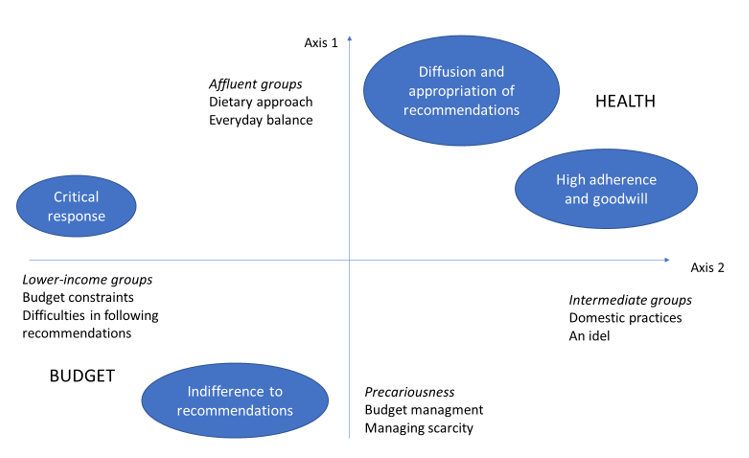
This graph represents in quadrant form the different relationships to nutritional recommendations.
Note : diagram derived from the analysis of 86 semi‑structured interviews based on a factorial analysis and an ascending hierarchical classification (AHC), covering 447 740 forms (words), of which 183 were discriminating lemmas 8.
Source : author (after Régnier, 2025)
The well‑off categories readily easily adopt the recommendations, with which they are familiar: those concerning food are well received, well understood and easily put into practice. Intermediate groups are receptive to them and keen to implement them, but they encounter difficulties in applying them, generating tension and guilt in the face of the gap between perceived ideals and daily practices. Working‑class categories are also aware of them, but they more often see them as an external imposition. Hence a more frequent opposition to the recommendations, which is also an affirmation of their tastes and way of life. Finally, people in deep precariousness show relative indifference : their priority remains access to enough food.
The update of the recommendations in 2017 introduced new elements. Acceptance of the guidelines on fruits and vegetables has progressed in working‑class groups. Their importance for health is mentioned more spontaneously. However, this adherence does not always translate into an increase in consumption, particularly among the most precarious, for whom intake remains insufficient9. Criticism persists, in the form of foods seen as good for others but not essential for oneself, or of a rejection of “plant‑based” or “organic” foods.
Furthermore, the perception of recommendations relating to meat consumption constitutes a major line of division. Upper and intermediate categories more frequently express adherence to the ideal of reducing – or even eliminating – meat products, which can serve as a marker of distinction. Conversely, working‑class categories willingly distance themselves from this norm, valuing meat for its taste, the pleasure it provides and the qualities attributed to it in terms of physical strength. Historically associated with luxury, meat remains a symbol of social achievement10.
Extending recommendations to environmental issues
Integrating these environmental dimension into the recommendations has helped reveal other social differences.
Research into the seasonality of eating practices highlights an opposition between two groups : on the one hand, individuals from affluent, educated, predominantly urban categories, for whom “eating in season” is a constraining norm that influences food choices in the name of the environment, accompanied by a cluster of other so‑called “sustainable” practices. On the other hand, individuals from lower-income backgrounds, subject to severe financial constraints, who declare that they “eat without seasons”. For them, seasonality is not a determining criterion in food choices, due to a lack of knowledge of seasonal rhythms or a desire to free themselves from them.
The environment is not a legitimate motivation for everyone. Individuals familiar with the rural world “eat in season” mainly out of a desire to support a local economy, out of proximity or even identification with local producers. Among working‑class seniors, following the seasons is taken for granted and a way of managing the household budget. Conversely, young, urban professionals are more detached from these practices linked to the agricultural world11.
Figure 2 – “Eating in season”? Social divides and diversity of motivations
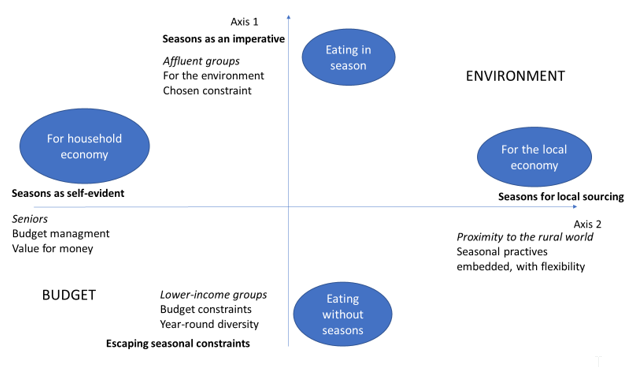
This graph represents in quadrant form theattitudes to seasonality of food.
Note : Axis 1 (15.9% of the variance) and axis 2 (8.2%) result from a principal component analysis (PCA) of 32 identified eating practices. They were then used as active variables in an ascendant hierarchical classification to identify homogeneous groups according to their practices and perceptions of seasonality 12.
Source : author (Régnier, 2025)
Digital mediation
The uses of digital tools for monitoring diet, weight and physical activity, for information on products, and for nutritional and environmental scoring13, vary across social groups. For individuals from affluent backgrounds, they fit into a preventative self‑care approach: they are seen as additional tools for controlling diet, physical activity and the environmental impact of food choices. For intermediate groups, they constitute ways of putting the links between food and health into practice, freeing themselves from the oversight of institutions – medical ones, for example – that dominate them. They make it possible to conduct intensive information seekings, often fuelled by mistrust of the agro‑food industry.
Working‑class groups are more reluctant or more constrained in their use of these tools, due to technical and financial obstacles, sometimes a lower degree of digital literacy, in a context where the “health” dimension of food is more distant. These tools are more often used to assist consumption
Tensions and social issues
How do dietary recommendations relate to with differences between social categories – in terms of economic resources and lifestyles – and with recent economic and social developments, in particular the rise in precariousness ? Differences in access to food and knowledge, the ways in which recommendations are disseminated, and the tensions that the ecological transition can provoke help to explain the persistent divisions across social categories.
Towards an increase in inequalities ?
Nutritional and environmental recommendations are spreading in a society marked by severe inequalities in access to valued foods (fresh fruits and vegetables, organic, local, seasonal products), to knowledge, to monitoring tools, but also to modes of consumption14. Thus, modest households devote a larger share of their budget to food and consume more starchy foods, sugary drinks and “fatty and sugary” products, whereas the better‑off consume more fruits, vegetables and labelled products15. The former buy more in supermarkets and hard discount while the latter shop at open-air markets, specialist shops and short supply chains.
These differences are not solely due to available financial resources. They are rooted in contrasting representations of “good eating”, of the body and of health, and now of the environment. These perceptions, embedded in social milieus, influence tastes, eating practices and the way dietary recommendations are perceived, interpreted or implemented. These differences widen health gaps, particularly in terms of obesity and diabetes, which affect members of the working classes more – and increasingly so – than others16.
Vertical diffusion and social resistance
As in the past, recommendations spread in a “vertical” direction. Thus we see forms of appropriations in the upper segments of modest categories, who are in employment and well integrated. But reception gaps remain significant, linked to several factors. Firstly, unequal familiarity with the recommendations : while nutritional prescriptions are now well known17, modest categories remain more distant from them. The environmental issues of food are even less well understood, because of the variety of criteria mobilized (production, transport, seasonality) and their complex interplay.
Differences are also due to the distance between recommendations and lifestyles. The more the two coincide, the easier their adoption, as in the affluent groups. Conversely, in lower-income groups, the guidelines may be perceived as a challenge to everyday practices, provoking rejection or resistance. Food pleasure and the valorisation of abundance, characteristic of the working classes, are difficult to reconcile with prescriptions perceived as restrictive (reducing meat, seasonality, organic).
Of course, these elements should not hide the internal heterogeneity of social groups : age, gender, place of residence or individual trajectories modulate the relationship to dietary recommendations, without calling into question the effect of social position.
The accumulation of recommendations can have a dissuasive effect on modest audiences. “Fresh, local, organic and seasonal” products are now widely valued for their nutritional or ecological virtues, whether scientifically established or not, but they remain inaccessible to a significant proportion of the population. Health and environment can also come into conflict. Modest categories have been encouraged to consume frozen or canned products because of their nutritional quality and because they help to reduce cost constraints, storage or horsehold equipment constraints. But canned products, in particular, suffer from a diffuse discredit, fuelled in particular by the recommendation to reduce packaging.
Wider developments in French society – slower growth, rising poverty rates – call into question the future of the vertical diffusion model. The polarization between the extremes of the social scale is increasing, as is internal fragmentation within groups, with a heightened risk of marginalization. The loss of legitimacy of the elites, particularly in the eyes of the middle classes, could weaken the intermediary role they play with regard to modest categories.
The ecological transition, between tensions and recognition of popular practices
The ecological transition opens up a new field of tensions and reconfigurations. The policies that accompany it provoke strong reactions, particularly among the working classes. This rejection is not aimed so much at ecology itself as at the way it is translated into measures perceived as unequal18. Paradoxically, many popular eating practices are already in line with environmental imperatives, although invisible in mainstream discourse: avoiding waste, eating pulses (lentils, dried beans, chickpeas), and among rural seniors, eating seasonally and sourcing locally.
These practices, although partly constrained by financial resources, are also based on a popular consumption ethic. Yet they are rarely highlighted, nor considered as ecological, and devoid of symbolic value. A series of recent studies now argue for their revaluation and underline that they too contribute to the ecological transition .
Conclusion
Research into the way dietary recommendations are received by target audiences shows strong social divides, particularly between working‑class and affluent groups. These gaps widen with the superposition of nutritional and environmental issues, perceived differently across groups. A central challenge for public policy is to adapt the recommendations to social realities, incorporating the constraints, aspirations and lifestyles of the working classes.
This implies not limiting oneself to health or ecological arguments alone, but recognizing other structuring dimensions (sound management of the household budget, tastes, etc.) likely to foster broader uptake. It will only be possible to make progress among the working classes on health and ecological issues if these issues are meaningful rather than perceived solely as constraints, and if the daily efforts embodied in eating practices are fully recognized.
In the longer term, several questions arise. Is the vertical diffusion scheme of recommendations still operative, as the phenomena of polarization and social fragmentation increase? How can we prevent current dynamics from leading to a worsening of inequalities, between part of the population socially equipped to respond to the most demanding recommendations and more vulnerable groups exposed to the risk of marginalization ? These questions, outlined here, deserve to be developed more fully .
Faustine Régnier
INRAE, UMR PSAE (University of Paris‑Saclay)
UMR SAGE (INRAE, CNRS, University of Strasbourg)
Footnotes
1 - Dubuisson-Quellier S. (dir.), 2016, Gouverner les conduites, Presses de Sciences Po. Boubal, C., 2019, « L’art de ne pas gouverner les conduites. Étude de la conception des campagnes de prévention en nutrition », Revue française de sociologie, 60 (3), pp. 457-481. Berlivet L, 2004, « Une biopolitique de l’éducation pour la santé. La fabrique des campagnes de prévention », dans D. Fassin et D. Memmi, dir., Le gouvernement des corps, Éditions de l’EHESS, pp. 37-75.
2 - Bergeron H., Castel P., Nouguez É., 2013, « Éléments pour une sociologie de l’entrepreneur-frontière. Genèse et diffusion d’un programme de prévention de l’obésité », Revue française de sociologie, 54 (2), pp. 263-302.
3 - Halbwachs M., 1912 [1970], La classe ouvrière et les niveaux de vie, Gordon & Breach..
4 - Bourdieu P., 1979, La distinction. Critique sociale du jugement, Éditions de Minuit.
5 - Revillard A., 2018, « Saisir les conséquences d’une politique à partir de ses ressortissants. La réception de l’action publique », Revue française de science politique, 68, pp. 469-491.
6 - Schwartz O., 1990, Le monde privé des ouvriers, Presses universitaires de France. Duvoux N., 2017, Les inégalités sociales, Presses universitaires de France.
7 - Régnier F., Masullo A, 2009 « Obésité, goûts et consommation. Intégration des normes d’alimentation et appartenance sociale » Revue française de sociologie, 50 (4), pp. 747-773.
8 - Régnier F., Masullo A., art.cit.
9 - Perignon M., Vieux F., Verger E.O., Bricas N., Darmon N., 2023, “Dietary environmental impacts of French adults are poorly related to their income levels or food insecurity status”, Eur J Nutr. 62(6):2541-2553.
10 - Régnier F., 2024, « Chapitre 8 : Transition écologique et normes alimentaires : les classes populaires sous tension », dans Conseil national des politiques de lutte contre la pauvreté et l’exclusion sociale, juin, Faire de la transition écologique un levier de l’inclusion sociale.
11 - See Ginsburger M., 2023, L’écologie en pratiques : consommation ordinaire et inégalités en France depuis les années 1980, thèse pour le doctorat en sociologie, Institut d’études politiques de Paris.
12 - Régnier F., Dalstein A.-L., Rouballay C., Chauvel L., 2022, “Eating in Season. A Lever of Sustainability?”, Sustainability 2022, 14, 5379.
13 - For instance: MyFitnessPal, Runkeeper, Yuka, Étiquettable.
14 - Institut Montaigne, 2024, Fracture alimentaire. Maux communs, remède collectif, octobre.
15 - Anses, 2017, Étude individuelle nationale des consommations alimentaires INCA3.
16 - Obesity affected 18 % of manual workers and less than 10 % of managers in 2020 : Fontbonne A. et al., 2023, « Prevalence of Overweight and Obesity in France », J. Clin. Med., 12, 925.
17 - Escalon H., Beck F., Bossard C., 2013, « Associations entre la connaissance des recommandations du PNNS et les comportements en matière d’alimentation et d’activité physique », Revue d’Épidémiologie et de Santé Publique, 61, 1, pp. 37-47.
18 - CNLE, op. cit. Comby J.-B., Malier H., 2021, « Les classes populaires et l’enjeu écologique », Sociétés contemporaines, 2021/4, 124, pp. 37-66
19 - Hugues F., 2024, « Débrouilles rurales : les modestes économes au prisme de l’ethnographie ethnocomptable de leurs espaces domestiques », thèse pour le doctorat en sociologie, EHESS. Granchamp L., Joly R., 2023, « Des écologies sensibles en quartier populaire », Espaces et sociétés, n° 188(1), pp. 37-54. Brocard C., Saujot M., Brimont L., Dubuisson-Quellier S., 2022, « Pratiques alimentaires durables : un autre regard sur et avec les personnes modestes », Décryptage, 1, Iddri.
20 - Régnier F., 2025, Distinctions alimentaires, Presses universitaires de France
Voir aussi
Transformations sociétales et grandes tendances alimentaires - document de travail n°13
27 février 2019Enseignement & recherche
Quels futurs pour les filières fruits et légumes françaises d’ici 2040 ?
13 novembre 2025Recherche, développement et innovation
Une prospective à 2040 pour l’agriculture biologique française - Analyse n°221
13 août 2025CEP | Centre d’études et de prospective