Lobbying on agricultural policies at the European level
Partager la page
The Analysis Notes present, in four pages, the key reflections on a current issue within the areas of responsibility of the French Ministry of Agricultur, Agrifood and Food Sovereignty. Depending on the issue, they may adopt a forward-looking, strategic, or evaluative approach.
Lobbying on agricultural policies at the European level
Broadly defined as actions aimed at influencing a political decision-making process, lobbying is a common and institutionalised feature of the development of European agricultural policies. This note examines how it operates, as well as the actors involved, outlining their profiles, resources, tools and modes of action. It shows that lobbying is carried out not only by representatives of agricultural trade union federations, but also by non-governmental organisations (NGOs) and associations. It mobilises actors with similar profiles, who have international careers and are specialists of the functioning of the European Union. They draw on a specific repertoire of tools, ranging from official negotiations to informal meetings, including the strategic use of expertise.
Introduction
Since the creation of the Common Agricultural Policy (CAP) in 1962, the European Union (EU) and Brussels have been major centres for the development of policies relating to agriculture. Bringing together the European executive, Member State representatives and Members of the European Parliament (MEPs), public affairs management operates through an open form of governance, broader than the usual institutional structures of government. It relies on the consideration of the interests and demands of numerous public and private stakeholders, giving a central role to lobbying.
“Lobbying” is defined as a set of influence practices over political decision-making processes, carried out by representatives of organised groups (businesses, associations, trade unions, NGOs, etc.) targeting political and administrative actors with the aim of promoting or defending specific interests.1 In political science, in its strict sense, lobbying refers to the use of specialised intermediaries (lobbying consultancies) who are paid to exert pressure on political decision makers. In its broader Anglo-Saxon definition, lobbying encompasses a wider range of formal and informal interactions between public and private actors, which may be carried out directly by an interest group or by a pressure group. At EU level, such practices are widespread.2 Agricultural lobbying is long standing, common and institutionalised. It is not specific to the agricultural and food sectors but also concerns interests related to industrial, environmental, and energy policies.
This note analyses the role played by lobbying in EU agricultural policymaking and explains the underlying logics. Moving away from a normative and journalistic view of lobbying as opaque and discreet, it shows that lobbying is in fact a common and legitimate mode of action in the elaboration of European policies, operating according to established rules and procedures. We use the broadest possible definition of lobbying, which includes actions undertaken by representatives of all segments of the agricultural and food systems, from upstream to downstream value chains, up to consumers. In addition, we focus on institutionalised lobbying processes; informal and unofficial practices (e.g. intimidation, corruption, threats), which are difficult to document, are not examined.
The first section reviews the history of lobbying on agricultural policies in Brussels and maps the actors involved. The next section focuses on the key spaces and moments of intervention of lobbyists, as well as their tools and modes of action. The final section examines the financial, human, social and symbolic resources of lobbyists, as well as their profiles and career trajectories.
Lobbying: an ordinary mode of action at European level
European governance and lobbying
Lobbying, officially recognised3 by the European institutions since the 2000s,4 aims to represent the interests and demands of various social groups and economic sectors in political decision making. According to the European Commission, it enables stakeholders’ positions to be taken into account with a view to facilitating consensus early in the legislative process and preventing open conflict. Presented by some as a neutral, depoliticised and democratic mode of decision making,5 European governance is perceived by others as a “technocratic” process in which private interests are prioritised.6
Linked to European integration since the 1950s, lobbies and pressure groups gained importance as the European administrative system and economic space expanded. A market for interest representation gradually emerged, with the European level becoming unavoidable for businesses.7 Lobbyists have professionalised, while institutions have become more dependent on their expertise as their legal and regulatory competences expanded. Lobbying has progressively become generalised as a mode of interaction and policy production between the EU administration and private interests.
These activities were codified with the creation in 1995 of a register for lobbyists accessing the European Parliament, followed in 2008 by the Commission’s Transparency Register, listing organisations and individuals engaged in lobbying activities. These two platforms merged in 2011 into a single register for all EU institutions. The most recent 2021 interinstitutional agreement defines the activities covered, the information lobbyists must disclose, and includes a code of conduct and a complaint and reporting procedure. Lobbying is therefore considered a legitimate and ordinary practice in Brussels today. It intervenes at all stages of the legislative process, far from a normative or journalistic portrayal as opaque and discreet. Lobbying constitutes a form of indirect political participation, enabling the integration of stakeholder interests into decision making, provided ethical and transparency rules are respected.
European lobbies on agricultural policies
Lobbying activities involve a diversity of organisations and individuals with varied interests and resources (table 1). Economic interests coexist with social, environmental and cultural interests which, although historically less influential and structured, are now often just as organised. Among the 14 000 organisations registered in the EU Transparency Register in 2024, NGOs are nearly as numerous as private companies (around 3 800 each), and almost 30% represent non-commercial interests.
National organisations are often grouped into transnational sectoral federations based in Brussels, to which lobbying activities are delegated. They have internal lobbying units specialised in EU legislative procedures and influence strategies. The most influential organisations multiply lobbying channels by combining representation through these sectoral federations, through cross sectoral groups, through lobbying firms, and through their own direct representation.
Like private organisations, think tanks, research centres and universities also have teams tasked with promoting their ideas and interests to the institutions. For example, the Jacques Delors Institute ranked 11th among French actors with the highest declared lobbying expenditure in Brussels in 2017 (between €1 and €1.4 million), according to LobbyFacts.
Table 1 - Different categories and examples of European lobbies in the agriculture and food sectors
| Types of lobbies | Examples of organisations with lobbying teams |
|---|---|
| Transnational federations of trade unions and professional agricultural organisations | Committee of Professional Agricultural Organisations (Copa) General Confederation of Agricultural Cooperatives in the EU (Cogeca) European Coordination Via Campesina (ECVC) Representatives of organic farming: IFOAM Organics Europe |
| European federations of associations or NGOs | European Environmental Bureau (EEB) European Bureau of Consumers’ Unions (BEUC) Animal welfare advocates: Eurogroup for Animals |
| Federations of companies or industries linked to the agricultural and agri-food sectors | Representatives of the food industry: FoodDrinkEurope European Retail and Wholesale Federation Representatives of collective catering: FoodServiceEurope Representatives of the seed, fertiliser, pesticide, packaging, machinery, biofuel, methanisation, agrivoltaics sectors, etc. |
| Cross-sectoral lobbying groups | Employers’ lobby BusinessEurope, including for example the French MEDEF European Round Table of Industrialists (ERT), whose members include Heineken, Nestlé, etc. |
| Lobbying, law and consultancy firms | Lobbying firms specialised in agriculture and food (e.g. Acumen Public Affairs, Rud Pedersen Public Affairs) Agricultural and food policy units within large generalist consultancy firms (e.g. FleishmanHillard, PwC, Deloitte, EY) |
| Think tanks, foundations, universities, research centres | Think tank: Institute for European Environmental Policy (IEEP) European Foundations for Sustainable Agriculture and Food Wageningen University Jacques Delors Institute |
Source : author
These organisations enjoy varying degrees of leverage depending on their budgets, seniority, scope of intervention and the relationships they maintain with EU institutions. Overall, major agrochemical groups (e.g., Syngenta, Bayer) tend to be the most influential, thanks to extensive networks and significant financial capacities. Over the course of European integration, institutions have valued different types of actors and partners. Until the 1980s, representatives of the dominant agricultural unions enjoyed privileged access to EU bodies, particularly the Directorate General for Agriculture and Rural Development (DG AGRI).8 From 1985 onwards, sector specific federations (e.g., the International Confederation of European Beet Growers) emerged. They provided specialised expertise on particular sectors and sometimes adopted policy positions that diverged from those of the dominant unions. This strengthening of political representation of specific agricultural sectors, rather than the profession as a whole, has been described by Marie Hrabanski as a “sectoralisation of representation”.9 This shift emerged as different policies gained autonomy (e.g., the establishment of Common Market Organisations for specific sectors such as wine or sugar). Dominant unions were also weakened by the rise of new actors (e.g. environmental NGOs) and by the involvement of other Commission Directorates General (e.g. DG SANTE, DG ENV) in agricultural governance. For example, the European Commission provided financial support for the creation of the European Environmental Bureau (EEB) and the European Consumer Organisation (BEUC), in order to build interlocutors capable of representing environmental and consumer interests, helping the Commission to address these new areas of competence as they emerged at the EU level.
The lobbying “repertoire of actions”
Key stages and spaces of EU agricultural lobbying
Agricultural lobbying in the EU is conducted vis à vis the three main institutions – the Commission, the Council and the Parliament – as well as the agencies and operational bodies linked to them. While lobbies seek to shape administrative and regulatory norms in their favour or to access resources (e.g., subsidies, support schemes), political and administrative actors also have an interest in these exchanges: receiving pre-constructed dossiers or “ready-made” amendments, gathering expertise, accelerating decision making processes, etc. Overall, interactions with lobbies contribute to the institutions’ legitimacy building strategy, which relies on taking account of, and giving voice to, civil society interests.
The repertoire of action used by lobbyists comprises several registers. Four main types may be distinguished: negotiation and consultation, use of expertise, protest, and judicialisation (recourse to judicial authority).10 Although lobbies do resort to protest (e.g. farmer demonstrations outside EU institutions) and judicialisation (e.g. legal action against the proposed Omnibus Directive in April 2025), the first two tools are generally preferred.
Lobbies participate in official negotiations at several key moments of the legislative process, particularly upstream of a proposal through the Commission’s written public consultations or through formal meetings (e.g., with the Directorate General drafting the initial version) (figure 1). These interventions before the Commission – which holds the right of initiative – allow lobbies to have significant influence over the framing and content of a legislative text (position papers, drafting proposals, etc.). Such interactions also enable them to maintain ties with key institutional actors and to obtain early information.
A large number of interactions also take place informally and unofficially. For example, the independent media DeSmog investigated lobbying activities targeting the European People’s Party (EPP) following the launch of the “Farm to Fork” strategy in 2020. One in six meetings was reportedly not declared on the European Parliament’s website or in official meeting registers, and 20% of the lobbyists involved were not registered in the Transparency Register.11 Interactions between lobbyists and European officials therefore take place in informal settings (bars, restaurants, etc.) or at networking events (“after work” gatherings, receptions, forums, etc.). Establishments around Place du Luxembourg, opposite the European Parliament, are major venues for such informal lobbying. On Thursday evenings, they host meetings beyond institutional boundaries.12 In addition to these, many social spaces gather people working in the “Brussels bubble” (sports clubs, schools, private clubs, etc.).
Figure 1 - Key moments of intervention by agricultural lobbies in the European legislative process: the example of the Soil Monitoring Directive from 2022 to 2025
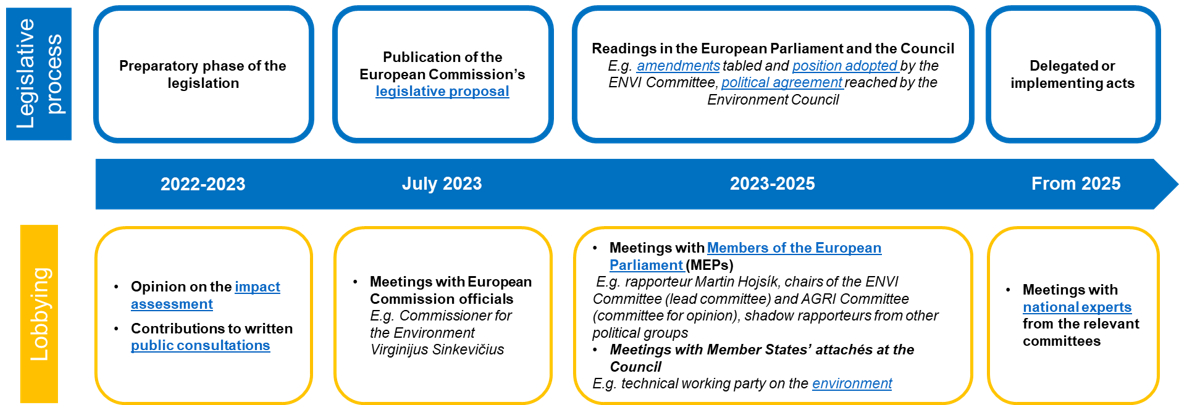
This timeline shows the stages of the European legislative process at which lobbyists may intervene, illustrated through the example of the Soil Monitoring Directive from 2022 to 2025.
Download the PDF version of the timeline
Source : author
Lobbying is also carried out throughout the readings of legislative texts by the Parliament and the Council, and subsequently during the drafting of delegated and implementing acts by the Commission. As the Parliament and the Council cannot amend these acts, lobbyists meet with the experts sitting on the committees that draft them. These arenas are significant because key decisions are often shifted into these secondary acts in order to facilitate the rapid adoption of a text. For example, the regulation establishing a certification framework for carbon removals and carbon farming was adopted by deferring to delegated acts the list of certification methods applicable to agricultural activities.13 Another example is the EU’s Carbon Border Adjustment Mechanism, which allows the Commission to extend its scope to additional products and goods through delegated acts.
Use of expertise and division of lobbying work
Within the repertoire of actions of lobbying, expertise is particularly used to defend interests, in an objectified form, drawing on the scientific register that is valued by the institutions.14 Expertise is often used to avoid relying on political argumentation.15 For instance, within the Commission’s advisory groups, the sugar sector transforms political issues (such as its opposition to DG AGRI’s policy on sugar surpluses) into technical debates by means of scientific rhetoric (e.g. precise calculations and economic terminology).16 To support their positions, some lobbies even finance scientific or science-based studies. Thus, in examining applications for the re-authorisation of glyphosate, the European Food Safety Authority (EFSA) and the European Chemicals Agency (ECHA) relied on data provided by the companies selling this product, including scientific studies they had commissioned, which have been contested by other researchers.17
Agriculture related lobbies also delegate certain activities to consultancy firms and specialised media outlets. These actors have positioned themselves within the division of work related to interest representation between institutions and pressure groups, using their expertise and networks to perform tasks previously carried out by the lobbies themselves, thereby becoming indispensable. These consultancies sell services such as advocacy strategies, political briefing materials, and lists of key MEPs or officials. Specialised media outlets (such as Contexte, Agra Europe, etc.) produce daily briefings on EU political and legislative developments. Politico Europe offers a paid subscription to its “Agriculture and Food” section, which provides access to documents (e.g., draft directives), actor mapping, and operational summaries on legislative proposals. The outlet has therefore taken over tasks previously performed by lobbies. It even offers clients the possibility to sponsor articles to promote their interests, and organises events bringing together the private sector and public administration, acting as a broker.18
What future for European lobbying on agricultural policies?
If the trend towards renationalising the CAP continues, lobbying could become more prominent at Member State level. The organisation of lobbies into transnational federations would then be questioned, as would be the influence linked to the centralisation of positions in Brussels. The emergence of regional coalitions built around shared agricultural issues could also be envisaged (e.g., an eco-scheme specific to a European region), creating new spaces for lobbying.
The accession to the EU of countries with significant agricultural potential (e.g., Ukraine, Turkey, the Western Balkans) would alter agricultural policy (hectare-based payment systems, distribution of subsidies, environmental standards, etc.). The balance of qualified majority voting in the Council would be affected, giving substantial weight to populous new entrants. The arrival of new lobbies would reshape the balance of positions and introduce new issues and demands.
An institutional reform granting greater powers to the European Parliament, including the legislative initiative, could in the future shift part of lobbying activities from the Commission to the Parliament. Efforts to increase transparency could lead European institutions and agencies to systematise the use of independent scientific advice in the legislative process, or to equip themselves with their own investigative capacities in order to reduce dependence on data provided by lobbies.
The resources of lobbyists in the agricultural and food sectors
Lobbying expenditure
At least 1.5 billion euros is estimated to be spent annually on lobbying in Brussels across all sectors, and these expenditures have increased by 33% since 2020. According to a survey conducted in early 2025, based on declared amounts that are often underestimated, the agri-food industry and chemical sectors ranked fourth in lobbying expenditure (45 million euros in 2024, after the technology, banking/finance and energy sectors), driven in particular by Bayer, the European Chemical Industry Council (CEFIC), and the chemical manufacturer BASF. The food sector ranked twelfth (4.75 million euros), led by McDonald’s, the Dutch Poultry Industry Association, and the Schwarz retail group, owner of Lidl. Lobbying expenditure related to agriculture and food declared in the Transparency Register is however significantly below the actual level of influence activities observed. For example, in 2020, the NGO EEB declared more than 7.3 million euros in lobbying expenditure for 221 “high level” meetings since 2014 and 32 lobbyists involved, whereas Copa Cogeca declared far lower expenditure (1.6 million euros) for 530 meetings and 36 lobbyists.
A strong endowment in “European capital” among agricultural lobbyists
Within the European institutional space, actors’ power is conditioned by their possession of a specific “European capital”: international profiles, experience within the institutions, career paths, social position, etc.19 European officials hold a dominant position in this field, due to their strong integration into decision making arenas, their possession of international social resources, and their extensive experience in European affairs. In this ecosystem, the influence of a lobby is measured less by its financial capacity than by its position relative to the institutions, and the relationships it manages to establish and maintain with them, drawing on its social and symbolic resources. European lobbyists working on agricultural policies (e.g., those representing businesses, associations, trade unions, NGOs) have profiles and resources similar to those of civil servants. This shows their proximity with EU civil servants as “permanent actors” of this field (longevity of experience, extensive networks, multiple languages spoken, expertise, etc.).20 Their integration into this relatively closed and homogeneous space contributes to their European socialisation. They interact almost daily with EU officials and MEPs, in professional, social and even private or family settings. Through these interactions, they acquire an understanding and master institutional rules and conventions, and internalise the EU’s specific public action norms. European officials and lobbyists thus share the same language, skills, behavioural codes and professional norms.
An analysis of the profiles of Copa Cogeca and EEB staff responsible for lobbying activities on behalf of their members confirms their status as “professionals of Europe” (table 2).21 They possess significant international resources, notably networks developed abroad during their studies or professional experiences. They speak an average of four languages. Their training and careers are international, with professional experience in an average of 3.5 countries for Copa Cogeca staff and 4.2 countries for EEB staff, rising to as many as seven countries. They also have a high level of education: all lobbyists hold at least one master’s degree, and more than half of EEB’s lobbyists hold two. Their training was completed at prestigious universities (Harvard, etc.) or institutions (Sciences Po).
Table 2 - Sociography of two major European agricultural and environmental lobbies
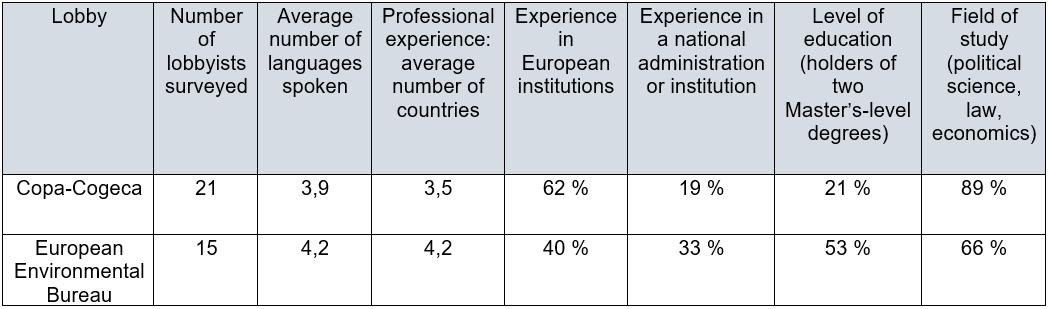
This table compiles various sociological characteristics of lobbyists employed by the EEB and Copa-Cogeca, including educational background, languages spoken, professional experience, and related information.
Source: author, based on LinkedIn
The profile of these lobbyists is closer to that of generalists in European public affairs than to that of technical specialists or activists.22 Most have studied European affairs, European law, international relations, political science or economics rather than technical disciplines (agronomy, environmental sciences, etc.), reflecting their possession of a distinct European form of capital. Finally, the social proximity between these lobbyists and European officials is strengthened by their extensive experience within the institutions, confirming the permeability between these groups of actors. Sixty-two per cent of Copa Cogeca staff engaged in lobbying activities, and 40% of those at the EEB, worked in a European institution before joining their current organisation. These experiences enabled them to develop knowledge and skills relating to the European administration and its bureaucratic logics - resources they were subsequently able to reinvest in the defence of private interests (procedures, language, networks, administrative norms, etc.).23
Conclusion
Lobbying, in its broadest sense, may be defined as a set of more or less formal influence activities carried out by representatives of organised groups (businesses, associations, trade unions, NGOs, etc.) targeting political and administrative actors with the aim of promoting or defending particular interests. It is a common and institutionalised mode of action at European level, on policies relating to agriculture and food. It contributes to the European legislative process by enabling the interests of a wide range of stakeholders to be taken into account. Despite differing levels of influence and room for manoeuvre, lobbying involves representatives of agricultural trade unions as much as environmental NGOs, consumer protection associations or agri-food, seed and pesticide industries. These actors draw on a variety of registers and tools to promote their interests: consultation, negotiation, production of expertise, etc.
Beyond financial resources, social and symbolic resources are critical within the European institutional sphere for carrying out lobbying activities. Agricultural lobbyists thus form part of an elite socialised into Europe: they possess the same knowledge and master the same codes as the European political administrative personnel. Their familiarity with European public affairs and their detailed understanding of a specialised sector, place them in the position of intermediaries - or even interpreters - between different social worlds, giving them a strategic role within the EU’s power structure.
Marie Martinez
Centre for studies and strategic foresight24
Notes de fin
1 - Kerléo J.-F., (dir.), 2020, Le lobbying. Influence, contrôle et légitimité des représentants d'intérêts, LGDJ.
2 - Michel H., (dir.), 2005, Lobbyistes et lobbying de l'Union européenne. Trajectoires, formations et pratiques des représentants d'intérêts, Presses universitaires de Strasbourg.
3 - From the 2000s onwards, the European institutions officially referred to interest representation activities as ‘lobbying’. These activities were gradually recognised by:
- the 1992 Treaty on European Union, which recognised the importance of consultation and dialogue with representative associations and civil society;
- the 2001 White Paper on ‘New European Governance’;
- the 2005 European Transparency Initiative, which aims to regulate lobbying activities;
- the creation of various transparency registers for lobbyists.
4 - Kerléo J.-F., op. cit.
5 - Aldrin P., Hubé N., 2016, « L’Union européenne, une démocratie de stakeholders. Des laboratoires du participationnisme à l’expérimentation démocratique », Gouvernement et action publique, 5(2), p. 125-152.
6 - Pitseys J., 2010, « Le concept de gouvernance », Revue interdisciplinaire d'études juridiques, 65(2), p 207-228.
7 - Laurens S., 2015, Les courtiers du capitalisme, Milieux d’affaires et bureaucrates à Bruxelles, Agone.
8 - Hrabanski M., 2011, « Les groupes d'experts de la DG agri : diversité des usages de l'expertise et socialisation aux normes d'action publique de l'Union européenne », Politique européenne 2011/3 n°32, p. 99-123.
9 - Hrabanski M., 2010, « Le syndicalisme agricole européen : vers une disjonction entre les organisations professionnelles et les associations spécialisées ? », Économie rurale 2010/3 n°317, p.17-26.
10 - Saurugger S., 2017, « Les groupes d’intérêt et l’Union européenne », in Costa O. et Mérand F. (dir.) Études européennes. Bruylant, p. 173-204.
11 - Carlile C., 2023, « Meetings Blitz Between Big Ag and Anti-Green Lawmakers in Europe », DeSmog.
12 - Lundy D., 2017, Lobby Planet Bruxelles. Petit guide de la lobbycratie à Bruxelles, Corporate Europe Observatory.
13 - Hubert A., 2023, « L’acte délégué, outil tendance mais controversé de la fabrique européenne de la loi », Contexte.
14 - Baisnée O., Smith A., 2006, « Pour une sociologie de l’apolitique : acteurs, interactions et représentations au cœur du gouvernement de l’Union européenne », in Cohen A., Les formes de l’activité politique, PUF.
15 - Robert C., 2003, « L’expertise comme mode d’administration communautaire : entre logiques technocratiques et stratégies d’alliance », Politique européenne, 2003/3 n°11, p. 57-78.
16 - Hrabanski M., 2011, op. cit.
17 - Laurens S., 2023, « Le glyphosate, révélateur de l’influence des lobbys industriels sur la « science réglementaire », The Conversation.
18 - Crozier M., Friedberg E., 1977, L’acteur et le système, Éditions du Seuil.
19 - Georgakakis D., 2012, Le champ de l’Eurocratie. Une sociologie politique du personnel de l’UE, Economica.
20 - Georgakakis D., (dir.), 2002, Les métiers de l’Europe politique. Acteurs et professionnalisations de l’Union européenne, Presses universitaires de Strasbourg.
21 - Analysis by the author of the LinkedIn profiles of 21 Copa-Cogeca lobbyists and 15 EEB lobbyists working on agricultural, food, biodiversity, water and soil issues, as well as on European institutions and governance.
22 - Michon S., 2022, « Le lobbying dans l’espace des métiers de l’Europe. Une analyse relationnelle des auxiliaires de l’Europe politique », Beauvallet W., Robert C., Roullaud E., EU Affairs: Sociologie des Lobbyistes Européens, Peter Lang.
23 - Laurens S., op. cit.
24 - At the moment this note was written.
Voir aussi
Le mécanisme d’ajustement carbone aux frontières de l’Union européenne : enjeux et perspectives pour le secteur agricole- Analyse n° 207
13 décembre 2024CEP | Centre d’études et de prospective
PAC et subsidiarité : vers une nouvelle gouvernance agricole européenne ? - Analyse n°148
03 février 2020CEP | Centre d’études et de prospective
Les questions agricoles dans les enceintes du multilatéralisme - Analyse n° 178
02 septembre 2022CEP | Centre d’études et de prospective
MOND'Alim 2030. Panorama prospectif de la mondialisation des systèmes alimentaires
28 septembre 2017Enseignement & recherche