The forest-wood sector in Bourgogne-Franche-Comté: what trajectories for forest areas by 2040 ?
Partager la page
The Analysis notes present, in four pages, the key insights on a current topic within the scope of action of the Ministry of Agriculture, Agrifood and Food Sovereignty. Depending on the issue, they adopt a forward-looking, strategic, or evaluative approach.
The forest-wood sector in Bourgogne-Franche-Comté: what trajectories for forest areas by 2040 ?
The forest-wood sector in the Bourgogne-Franche-Comté region faces numerous challenges, particularly those related to sanitary crises and climate change. In response, a forward-looking study was commissioned by the Ministry of Agriculture, Agri-Food and Food Sovereignty, co-financed by the Région Bourgogne-Franche-Comté and the interprofessional organization Fibois. It was carried out by Solagro, Eepos and Futuribles from September 2024 to March 20261. The study shows that the future of the sector depends heavily on the priority given to the economic role of forests and on the choice of forest management practices. It also highlights the need to strengthen consultation frameworks, both within the sector and with civil society.
Introduction
With more than 1.7 million hectares of forest, Bourgogne-Franche-Comté (BFC) is a major forested region. The main species harvested are fir, spruce, Douglas fir, oak, and beech. Its forest-wood sector accounts for 15% of national harvests, produces 8.4 million cubic meters (Mm³) per year (around 39% of which is sawlogs), and represents 20,000 jobs in the region. While the regional forest-wood agreement sets out an ambitious vision for the 2018–2028 decade, based on a sustainable increase in harvesting, the sector is facing major challenges, particularly related to sanitary crises and climate change. The region has in fact experienced a 25% decline in net biological production between 2020 and 2024 (from 10.3 to 7.7 Mm³/year)2, partly caused by bark beetle outbreaks, insect pests that affect spruce stands.3 These disturbances are accompanied by significant episodes of decline and mortality due to droughts. Downstream, the sector suffers from a shortage of labor and faces a fluctuating economic and political context: energy crisis, new regulations, etc. At the same time, societal expectations are increasing regarding forest uses, biodiversity conservation, landscape amenities, and related concerns.
Faced with these challenges, the Regional Directorate for Food, Agriculture and Forestry (DRAAF) of Bourgogne–Franche–Comté commissioned a foresight study, co-financed by the Regional Council and the interprofessional organization Fibois BFC. The study was carried out by the consortium composed of Solagro, Eepos, and Futuribles and took place from September 2024 to March 2026. It aimed to explore the likely futures of the regional forest–wood sector by 2040 and to engage local stakeholders in this process: forest owners, forest managers, forestry contractors, wood industry companies, public administrations, local authorities, environmental protection organizations, among others. The study focused on three contrasting territories: the Morvan massif, the Jura massif, and the broadleaf stands of the Saône Valley and Fossé Bressan (Figure 1). Workshops were organized in these areas with stakeholders in order to develop prospective scenarios, assess their implications, and provide a basis for lessons at the regional scale.4
Figure 1: Location of the three study areas within the Bourgogne–Franche–Comté region
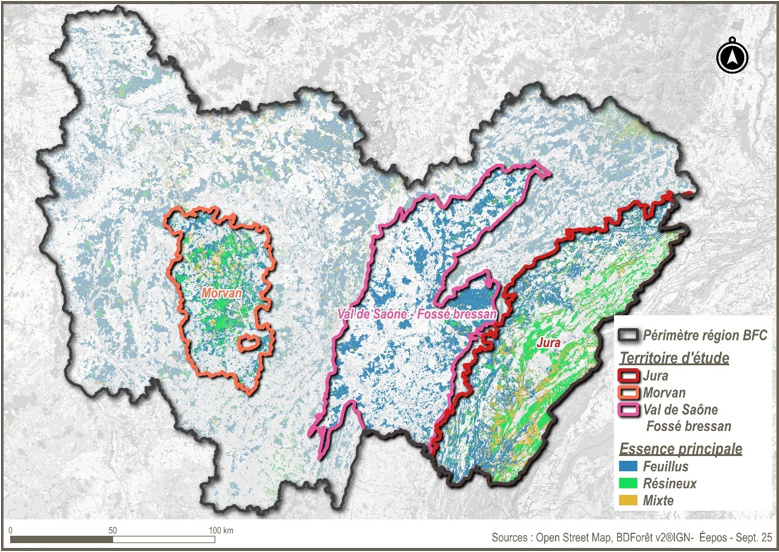
Cette carte de la région Bourgogne-Franche-Comté montre où se situent les trois territoires d’étude et les forêts.
This map of the Bourgogne–Franche–Comté region shows the location of the three study areas and forest cover.
Source: Eepos, based on data from the French National Institute of Geographic and Forest Information (IGN, 2024)
This analysis describes the evolution pathways of the forest–wood sector in Bourgogne–Franche–Comté (BFC) through to 2040. The first section presents the three study areas. The second addresses the risks associated with baseline trajectories, including decline and crisis scenarios. The third section presents three alternative pathways that could be considered to address these risks.
Three contrasting territories representative of the diversity of regional challenges
Jura: planning for the post-bark beetle outbreak period
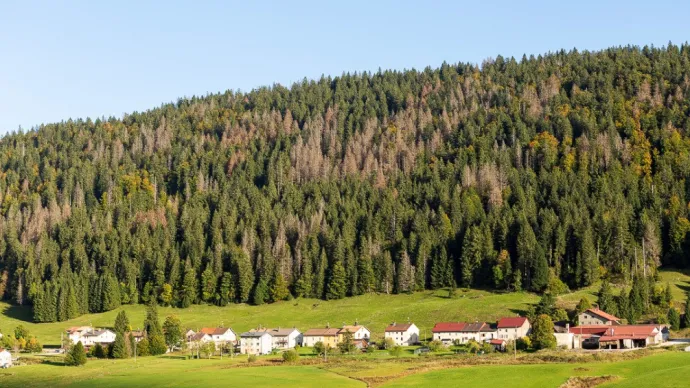
The Jura massif (Figure 2) comprises 360,000 hectares of forest, with a forest cover rate exceeding 40%. One third of the forest area is publicly owned (predominantly by municipalities), compared with a national average of approximately 25%. Forest stands are composed of 43% conifers, mainly fir and spruce. In 2022, these forests produced approximately 2 million m³ of timber, including 1.4 million m³ of sawlogs (sawn timber).5 Since 2018, major episodes of summer drought and unusually mild winters have increased the vulnerability of these stands to bark beetle outbreaks.6 With annual mortality and harvesting rates estimated at 20% and 132% of biological growth, respectively, the massif is undergoing a process of resource depletion.7 This has led to saturation of local industrial capacity and an increase in the export of harvested timber to other regions.
Figure 2: Spruce stand affected by bark beetle infestation in the Jura massif
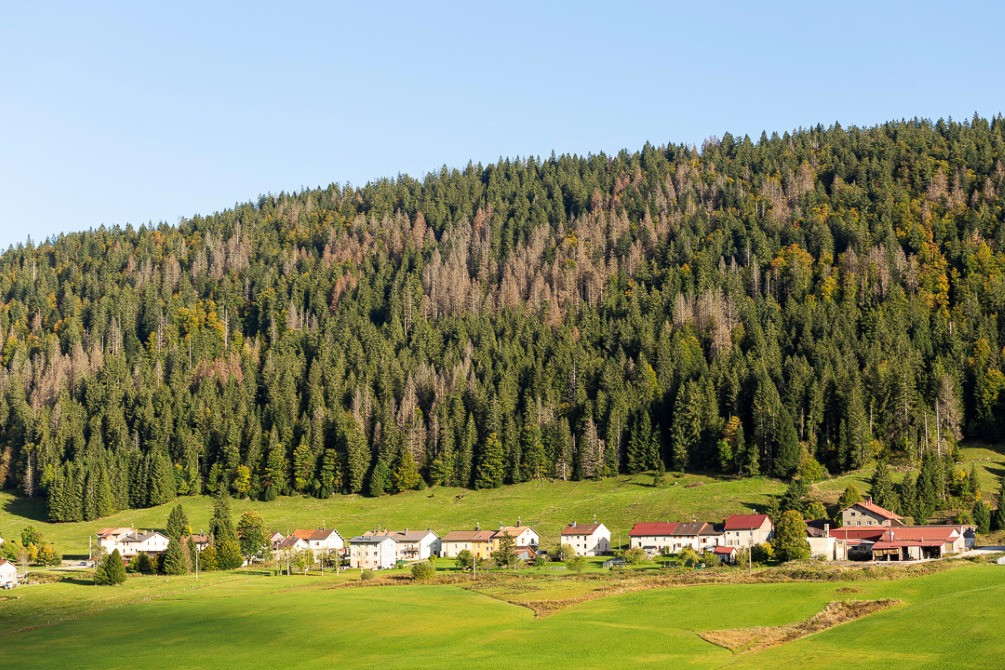
Cette photo montre une forêt d’épicéas du Jura affectée par les scolytes.
This photograph shows a spruce forest in the Jura affected by bark beetle outbreaks.
Morvan: maintaining a productive function in an uncertain context
With approximately 140,000 hectares of forest, mostly privately owned, the Morvan (Figure 3) is a productive massif specialized in conifer species. This territory is a pioneer in the silviculture and processing of Douglas fir. Introduced at a large scale in the BFC region in the second half of the 20th century, it represents today a majority of the 45% of forests composed of coniferous trees, and 25% of sawlogs produced in the region. The development of Douglas stands has generated local opposition due to the resulting landscape transformation (e.g., monospecific plantations and homogeneous forest structures). Today, Douglas stands are reaching maturity and are harvested through logging operations that can significantly alter the landscape and revive opposition, although these operations generally take place within the framework of sustainable forest management plans. The processing industry has a sawing capacity of approximately 1 million m³/year, half of which is supplied by timber from the massif. The harvest rate is close to 100% of biological growth. In recent years, harvesting intensity has tended to decline, notably in response to societal expectations. The sector faces a chronic labour shortage, and the sawmill infrastructure must adapt to increasing timber diameters. Nevertheless, territorial dialogue led by the regional natural park is of good quality, reflecting a willingness to evolve Douglas fir silviculture towards other management systems, including mixed and irregular stands, while reducing harvesting intensity (already observed) and diversifying resource use.
Figure 3: Douglas stands in the Morvan massif
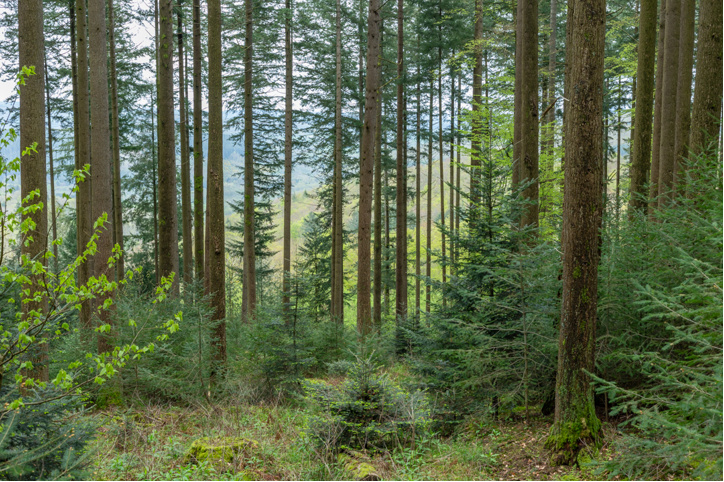
Cette photo montre une douglasaie du Morvan.
Saône Valley and Fossé Bressan: a sector in need of restructuring
This forest massif, which does not have a strong territorial identity, corresponds in this study to the “Saône–Bresse–Dombes” sylvo-ecoregion (Figure 4). Its 200,000 hectares of forest are composed of 94% broadleaves, mainly oak stands, yielding an annual harvest of 0.8 million m³, of which 25% is directed to sawlog (timber for construction and high-value uses) supply chains. This territory suffers from a lack of forest access infrastructure and from insufficient active management of forest parcels, largely due to fragmented land ownership. A declining trend in broadleaf timber quality is observed, linked to reduced owner engagement in silvicultural management and an increase in “pitted” wood affected by pests. At the same time, demand for industrial wood and energy wood is increasing. While this creates new market outlets, it raises concerns about increased pressure on forest stands and timber exports outside the region, calling into question the capacity to maintain high-quality sawlog production. The valorisation of high-value broadleaf sawlogs appears to be a key lever for the development of the local sector. However, this would require technical innovations (e.g., improved sorting), modernisation of processing facilities, and increased demand (e.g., for timber construction).
Figure 4: Oak stands in the Saône Valley and Fossé Bressan
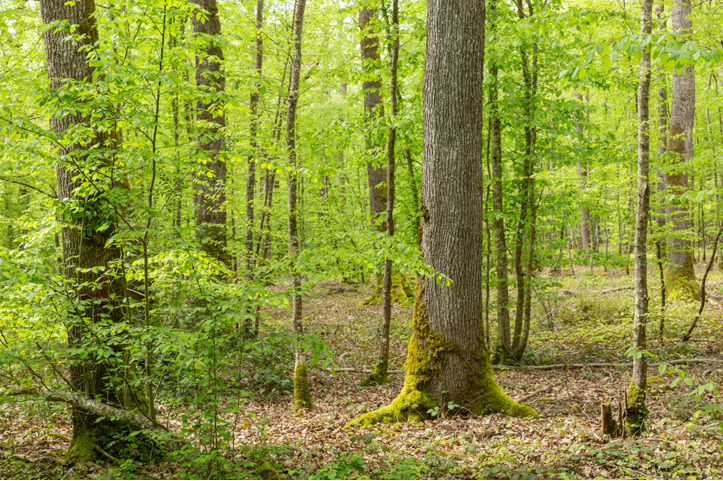
Cette photo montre une chênaie du Val de Saône.
This photograph shows an oak stand in the Saône Valley.
Economic decline of the sector and vulnerability to climate risks: three “endured” trajectories
For each of the three study areas, five forward-looking scenarios were developed during workshops. The comparative analysis of these territorially grounded scenarios revealed common patterns, which made it possible to define six “typical trajectories” applicable to the forest–wood sector across the Bourgogne–Franche–Comté region (Figure 5). In other words, a trajectory corresponds to a stylised regional-scale scenario derived from the aggregation of territorial scenarios sharing a common underlying logic. This set of trajectories forms a range of strategic possibilities to support regional stakeholders in projecting themselves into the future.
Figure 5: Mapping between regional trajectories and territorial scenarios
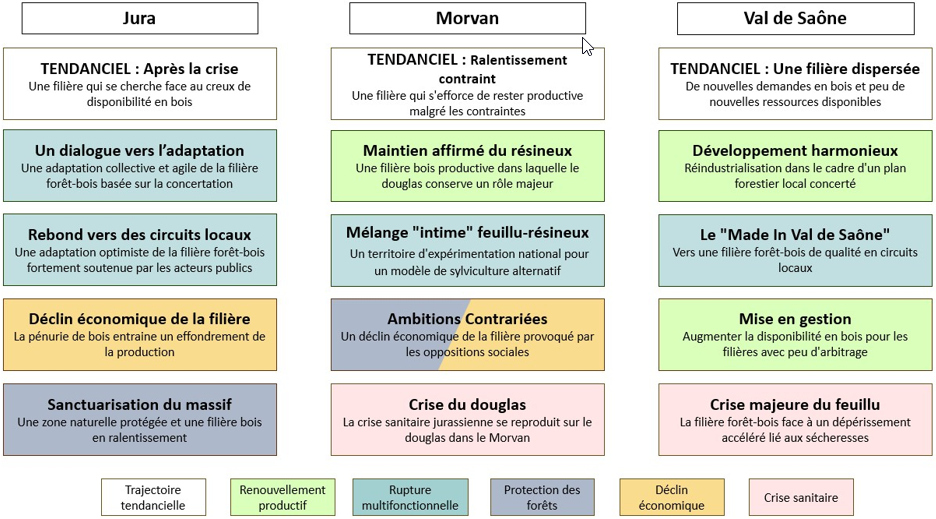
Ce schéma montre les correspondances entre les scénarios prospectifs construits à l’échelle des trois territoires d’étude et les trajectoires régionales identifiées.
This diagram shows the correspondence between the forward-looking scenarios developed at the scale of the three study areas and the identified regional trajectories.
Source: final report, page 153
The following sections describe trajectories that could emerge in the absence of clear strategic guidance for the regional sector, or in the event of an economic or sanitary crisis. Conversely, the third part presents what could occur if explicit and decisive choices were made regarding the objectives assigned to forests and the wood sector.
A baseline trajectory shaped by uncertainty and vulnerability
For each territory, a baseline scenario has been identified, corresponding to the continuation of ongoing dynamics without any significant strategic shift. In the Jura, despite a possible substitution effect towards fir, timber production is expected to slow down, leading in the medium term to a “dip in availability” that could affect the activity of processing industries. In parallel, societal tensions are expected to increase, particularly around “sanitary” harvesting operations. A marked decline in timber availability is also anticipated in the Morvan (of the order of 30% by 20408), accompanied by a reduction in harvesting levels, reflecting a “do less but better” approach. However, silvicultural practices are expected to diversify gradually, a transition supported by the territorial forest charter (in response to societal expectations), in order to adapt forests to future climate conditions. In the Saône Valley and Fossé Bressan, timber availability is expected to remain stable, while demand—particularly for industrial and energy wood (WIE) —could increase, intensifying competition for resources.
The “baseline trajectory” is thus characterised by a limited diversification of upstream forestry: attempts to introduce new tree species, moderate reductions in harvesting, and similar adjustments. These developments respond to rising societal tensions and concerns regarding sanitary conditions and environmental pressures. However, climate change and wildlife pressure make forest regeneration difficult and uncertain. In the absence of a clear roadmap, investments would be risky and therefore limited, both in forest management (e.g., access infrastructure) and in processing facilities. The entry of new WIE actors could also create new competitive pressures, while economic stakeholders may find themselves increasingly vulnerable to fluctuations in international demand. Nevertheless, in the absence of a major crisis (see below), historical processing chains are expected to persist thanks to gradual improvements in industrial equipment. The ongoing consolidation of the sector is also likely to continue. Social mobilisation in favour of stronger forest protection is expected to persist as well, potentially exacerbating tensions with the sector.
The economic decline trajectory: a degraded baseline scenario
The “economic decline” trajectory corresponds to a strong deterioration of the baseline situation, driven by an intensification of currently observed signals (labour shortages, difficulties in maintaining managed forest areas, dieback, etc.) or by an external shock (economic crisis, etc.). In this scenario, risks (natural and economic) are poorly anticipated, and a lack of overall coherence prevents long-term planning.
In “economic decline” scenarios, sector activity would decrease significantly, and forestry would become a neglected sector due to insufficient resources, lack of public support, and weak territorial dialogue. Investments in forests, which would remain limited, would be insufficient to maintain productive functions and timber quality. Processed volumes would decline, and some processing facilities would shut down, further reducing the attractiveness of sector-related professions. WIE supply chains would be less affected than sawlog-oriented chains, as they are less demanding in terms of resource quality and would therefore remain operational. Silvicultural management would adapt accordingly, focusing primarily on supplying this lower-quality wood segment.
The “economic decline” trajectory is particularly feared by stakeholders in the Jura, in the event that the sector fails to recover from the recent bark beetle crisis, and by those in the Morvan, where increasing societal opposition could constrain economic development ambitions.
Sanitary and climatic crisis trajectory
The “crisis trajectory” is based on the assumption that major sanitary or climatic hazards could significantly disrupt the forest–wood sector across the study areas. In the Morvan, the arrival of the American bark beetle Dendroctonus pseudotsugae could cause damage to Douglas fir comparable to that observed on spruce in the Jura. In the Saône Valley and Fossé Bressan, the increase in annual heatwaves, such as those of 2018, 2020, and 2022, could lead to severe and long-lasting dieback in broadleaf stands. Forests could also be affected by an introduced pathogen, such as the fungus Ceratocystis fagacearum, responsible for oak wilt. The main challenge would be economic: limiting the deterioration of timber quality while maximising its use for sawlog production. In the Morvan, the challenge would also be logistical, requiring timber conservation solutions, such as water storage. In the Saône Valley, the valorisation of secondary broadleaves into sawlogs—markets for which are less mature—would likely prove difficult.
Measures identified in workshops to help territories prepare for such crises include trials of crisis-wood conservation methods and the establishment of anticipatory governance mechanisms (“storm plans”).
Three alternative trajectories assigning varying priority to the productive function of forests
The trajectories described above were considered “pessimistic” by workshop participants and characterised as “endured” developments. By contrast, the following trajectories could emerge if clear choices were made regarding the objectives assigned to the forest–wood sector. These trajectories are distinguished in particular by the importance given to timber production.
A “productive renewal” with positive economic and social impacts
This trajectory places the productive role of forests at the core of the economic development of territories. It is based on historically acquired experience and know-how (well-established species and technologies) and on a high degree of territorial specialisation (silviculture, industry), while taking into account emerging societal and environmental pressures.
Accordingly, the “affirmed maintenance of coniferous systems” scenario (Morvan) and the “bringing into management” scenario (Saône Valley) rely on species with high valorisation potential (Douglas fir and oak, respectively). These would primarily be managed in monocultures, leveraging recent research developments9. Under this trajectory, substantial financial resources would be allocated to upgrading industrial facilities, enabling the processing of a wide range of diameters and the valorisation of all available timber qualities, including from declining stands. It also assumes strengthened forest access infrastructure to enable timber mobilisation. The resulting economic dynamism would generate positive territorial spillovers: new forestry jobs, additional income for forest municipalities, and increased engagement of private forest owners. Support for training and efforts to improve the visibility of forestry and wood-related professions would further enhance sector attractiveness.
The main challenge of this trajectory lies in maintaining biological production in a context of increasing climatic hazards. Such a trajectory appears unlikely in the Jura, where productive species are already heavily affected by sanitary crises. Besides, a more active management of forest stands could generate fears, or tensions, concerning potential impacts on ecosystems (e.g. biodiversity) and landscapes. The specialisation of forests and enterprises could also increase their vulnerability to environmental risks (e.g., species-specific pests) or economic shocks (e.g., fluctuations in international demand). Furthermore, this trajectory, which relies on the continuation of an already contested silvicultural model, carries a heightened risk of conflict escalation, particularly in the absence of stakeholder consultation.
A “multifunctional rupture” in the organisation of the sector
The “multifunctional rupture” trajectory is based on a profound transformation of forest management and the organisation of the forest–wood sector, in order to make them more resilient to climate change. To preserve the economic role of forests, the trajectory relies on a de-specialisation of territories, implemented in differentiated ways across each area: reintroduction of broadleaves on a tree-by-tree basis in the Morvan, strong development of short supply chains in the Saône Valley, and accelerated renewal of the Jura massif through increased species diversity (e.g. hornbeam, aspen) and new processing enterprises (e.g. finger-jointed laminated timber made from secondary species, wood chemistry as a substitute for fossil-based products).
Under these scenarios, several silvicultural practices are promoted, including mixed-species stands, irregular forest structures, and the maintenance of set-aside areas. Governance based on strengthened facilitation at the massif scale would support coordinated management and improve public engagement and dialogue. Downstream, traditional processing chains would be complemented by a diversity of new small and medium-sized actors, enabling better valorisation of emerging resources (secondary species, declining timber). The resulting diversification of forests and value chains would generate multiple benefits: local products with higher added value (e.g. further secondary processing within the territory, including structural uses of aspen such as timber framing), improved resilience to climatic and economic risks, territorial economic revitalisation, reduced social tensions, and positive environmental externalities, including enhanced biodiversity and stronger ecosystem service provision.
The main limitation of this trajectory lies in the scale of the required changes (financial needs, shifts in practices across the entire value chain, etc.), which some local stakeholders consider unrealistic despite recognising its potential benefits. The risks of implementation failure, both upstream and downstream, are significant. Support for R&D on the transformation of secondary species, and the stimulation of market demand (e.g., through public procurement and incentives to buy local wood), would help enable this trajectory.
Forest protection and diversification of income sources
In the “forest protection” trajectory, priority is given to the ecological role of forests, particularly biodiversity conservation and ecosystem services (carbon sinks, water resource protection, soil protection, etc.). Timber production and processing would not cease entirely, but the economic function would no longer be considered a priority compared with other territorial objectives.
The slowdown in traditional forestry activity would be offset by new sources of income derived from environmental amenities. Forest management financed through these new instruments would primarily aim to ensure biodiversity preservation and forest adaptation to climate change. Timber harvesting would be directed mainly towards addressing mortality crises or anticipating them.
In the Jura, which has been heavily affected by environmental crises, this trajectory would enable forest renewal by setting aside its productive role. In the Morvan, such a “chosen protection” strategy could provide a response to growing societal pressures, provided that tourism and environmental amenities are effectively valorised.
Although partly contrary to the current interests of economic stakeholders in the sector, this trajectory would make it possible to plan and manage a reduction in wood production rather than endure it. This would require finding additional financial resources for forest owners (particularly municipal forests) and for actors in the processing industry : tourism taxes, payment for ecosystem services, crowdfunding, carbon credits, etc.10 The environmental functions of forests would be enhanced, and territories could become more attractive for tourism, generating new non-wood-related activities.
However, this trajectory would negatively affect the existing wood sector: deindustrialisation, job losses, erosion of skills, and reduced production of bio-based materials, increase in the imports of wood products and degradation of the commercial balance at the national scale. The implementation of this “amenities-based economy” remains largely undeveloped and represents a significant bet, which—if unsuccessful—could lead to the “economic decline” trajectory.
Conclusion
This note shows that, in the face of baseline or “endured” trajectories considered pessimistic, certain policy choices would enable stakeholders in the forest–wood sector of Bourgogne–Franche–Comté to steer it towards more desirable, chosen futures. The six trajectories presented were constructed as ideal types and are not intended to be implemented as such. They outline a range of options available to sector stakeholders, which can be combined and adapted to local contexts, and used as reference points in the development of territorial strategies.
The study highlights three trajectories in particular, distinguished by the importance they assign to the economic role of the forest–wood sector: a priority role in continuity with historical activity; a significant but reconfigured role aimed at increasing forest resilience; and, finally, a reduced role in favour of enhanced ecosystem protection, opening the way to a new economic model. A decline in industrial activity is broadly perceived by stakeholders as a pessimistic and undesirable outcome. In scenarios where it occurs, it is largely driven by climatic, sanitary, or societal crises. However, as illustrated by the “forest protection” trajectory, this decline could also be deliberately chosen and leveraged as an opportunity to enhance the environmental and recreational amenities provided by forests.
The analysis of these trajectories makes it possible to identify “no-regret actions” at the regional scale, aimed at steering away from the most negatively perceived developments. These include public awareness-raising, support for forest regeneration and stand maintenance (restoring the forest–game balance, forest fire prevention, etc.), facilitation among sector stakeholders to improve mutual understanding, and better valorisation of lower-grade timber. Additional measures could be implemented to maintain the productive role of forests, such as training forest owners in new management approaches or improving resource availability, including through enhanced forest management and infrastructure development.
In all cases, the implementation of any strategy requires strong involvement and support from public actors, whether financial, political, or regulatory. By outlining trajectories and possible actions, this study aims to provide a range of strategic perspectives to inform decisions to be made in the coming years at both territorial and regional levels.
Nicolas Bijon
Solagro
Julien Crosaz
Eepos
Frédéric Weill
Futuribles
Miguel Rivière
Centre d’études et de prospective
Notes de bas de page
1 - Solagro, Eepos, Futuribles, 2026, La filière forêt-bois face aux enjeux climatiques, sanitaires et sociétaux. Une prospective de la filière et de ses acteurs en Bourgogne-Franche-Comté à horizon 2040, rapport pour le ministère de l’Agriculture, de l’Agro-alimentaire et de la Souveraineté alimentaire : agriculture.gouv.fr/la-filiere-foret-bois-face-aux-enjeux-climatiques-sanitaires-et-societaux
2 - IGN, 2024, Inventaire Forestier National 2024.
3 - Chambre régionale des Comptes BFC, 2024, L’accélération du changement climatique : un défi majeur pour les forêts de Bourgogne-Franche Comté.
4 - The morphological analysis method was used. It consists in decomposing the system under study (here, the forest–wood sector) into a set of key variables for which assumptions about possible future developments are formulated. Their combination makes it possible to construct coherent evolution scenarios.
5 - INSEE, 2025, La filière forêt-bois dans l’Arc jurassien franco-suisse.
6 - In particular, the spruce bark beetle (Ips typographus), a species specific to spruce.
7 - IGN, 2024 (op. cit.), data processed at massif scale by Eepos.
8 - Bastick C., et al., 2024, Projection des disponibilités en bois et des stocks et flux de carbone du secteur forestier français, IGN, FCBA. The “C2” climate hypothesis of this study was used to simulate possible developments in the Morvan.
9 - For example, the Douglas-Avenir project (2021–2026).
10 - See for example the Low-Carbon Label (Label bas-carbone), WWF’s funding programme Nature Impact, and associative forest landholding structures (foncières forestières associatives).
Voir aussi
La vulnérabilité des forêts aux perturbations naturelles
07 novembre 2025Filière bois
Modélisation prospective et action publique dans le secteur forêt‑bois - Analyse n°204
11 juillet 2024CEP | Centre d’études et de prospective
Eau, agriculture et changement climatique en Bourgogne-Franche-Comté : éléments de prospective - Analyse n° 181
21 novembre 2022CEP | Centre d’études et de prospective
Prospective AFClim. Agriculture, forêt, climat : vers des stratégies d’adaptation - Analyse n° 46
16 juillet 2012Enseignement & recherche