Forest foresight studies in France: a comparative analysis
Partager la page
Analysis notes present, in four pages, the key reflections on a topical issue falling within the remit of the French Ministry of Agriculture, Agrifood and Food Sovereignty. Depending on the issue, they adopt a forward-looking, strategic or evaluative approach.
Forest foresight studies in France: a comparative analysis
Numerous foresight studies on the French forest sector have been conducted to inform decision-makers on issues such as the weakening of the carbon sink, adaptation to climate change and the economic competitiveness of the wood industry. This comparative analysis of seven French foresight studies shows that a delicate compromise is possible between preserving the carbon sink and moderately increasing timber harvests, provided that wood uses are optimised and the sector adapts to climate change. It also highlights the limitations of current foresight methods, which mainly focus on biophysical flows, and argues for more integrated approaches combining modelling, scenarios and stakeholder participation.
Introduction
The French forest sector lies at the heart of major challenges: producing timber to meet domestic demand, maintaining the carbon sink, adapting to climate change, investing and innovating in wood processing, mobilising timber resources in privately owned forests, preserving biodiversity, supporting recreational uses, and more. These long-term challenges are addressed through strategic planning documents covering one or several decades, such as the National Forest and Wood Programme 2016–2026 (PNFB), the National Low-Carbon Strategy (SNBC) with a 2050 horizon, and the National Climate Change Adaptation Plan (PNACC), which looks ahead to the end of the century. Supporting these strategies requires anticipating future changes.
Foresight is an approach that explores the future in order to inform decision-making today. It addresses long term issues through a range of disciplines and methods, including modelling, scenario-building and trend analysis. Over the past decade, numerous foresight studies have been published in France to contribute to the debate on the future of the forest sector and to inform and influence national strategies. Some focus on a specific theme (construction timber, etc.), while others adopt a cross-cutting perspective covering several issues.
This Analysis compares seven foresight studies published since 2017 (Figure 1). In particular, it examines how the content and findings of these studies relate to the main public policy challenges concerning forests and wood, with the aim of identifying key messages and highlighting possible gaps. Purely scientific publications1 (research articles, etc.), foresight studies focusing solely on one segment of the wood value chain2 and international foresight studies3 are not covered here.
Figure 1 – Examples of foresight studies for the forest-wood sector
| Title | Carried out by |
Commissioned by | Time horizon | Main topics |
|---|---|---|---|---|
| Enchantées ou désenchantées : quelles forêts françaises en 2100 ? (2025) | WWF, Carbone 4, Laboratoire des déviations écologiques | WWF | 2100 | Climate impacts Forest resources Ecosystems Governance |
| Projections des disponibilités en bois, et des stocks et flux de carbone du secteur forestier français (2024) | IGN, FCBA | MAASA, MTECT, ADEME | 2050, 2080 | Forest resources Carbon Wood Climate impacts |
| Scénario de convergence du bouclage bois biomasse à l’horizon 2050 (2024) |
Carbone 4 |
France bois forêt, CODIFAB, COPACEL |
2050 | Carbon Wood |
| Afterres 2050 Forêt et bois (2023) | Solagro, Afterres 2050 2050 | 2050 | Ecological transition Wood |
|
| Gestion forestière et changement climatique : une nouvelle approche de la stratégie nationale d’atténuation (2020) | Canopée, FERN, Les amis de la Terre | Funding from UE, European Climate Foundation, David and Lucile Packard Foundation, Fondation nature et découvertes | 2050 | Forest resources Carbon |
| Quel rôle pour les forêts et la filière forêt-bois françaises dans l’atténuation du changement climatique ? Une étude des freins et leviers forestiers à l’horizon 2050 (2017, 2020) | INRA, IGN | MAASA | 2050 | Forest resources Carbon Climate impacts |
| Projet Bicaff : Bilan carbone de la ressource forestière française (2017) | IPSL, CNRS, INRA, IRSTEA, université libre d’Amsterdam | Funding from ADEME | 2030, 2040 | Forest resources Carbon Wood |
Source : authors, from commissioners’ and publication websites
The first section provides an overview of the forest-related challenges addressed in national strategies and how foresight studies approach them. The subsequent section highlights several key findings relating to economic, environmental and societal issues. Finally, the third section examines the future of forest foresight in France.
Why and how should strategic foresight be used in the forest sector?
Forest foresight helps inform national strategies addressing climate, industrial and biodiversity-related challenges, among others. The seven foresight studies compared here mainly address these issues through modelling approaches, which vary depending on the commissioning body and the level of expertise of the teams involved. Timber harvests and carbon balance are the main variables examined, while other dynamics (economic, societal and environmental issues beyond carbon) remain less explored.
National strategies address major challenges
The forest-wood sector lies at the heart of climate-related challenges. National strategies highlight the need to adapt forest management practices to future climatic conditions (species selection, management of storm- or drought-damaged stands, etc.) and to strengthen a rapidly declining carbon sink.4 The National Low-Carbon Strategy (SNBC), for instance, relies on optimising the forest “carbon pump” to achieve climate neutrality. The National Climate Change Adaptation Plan (PNACC) places particular emphasis on strengthening wildfire prevention and reducing forest vulnerability, while one of the four objectives of the National Forest and Wood Programme (PNFB) is dedicated to climate change mitigation and adaptation in forests.
Economic challenges are also central and concern both upstream forestry activities (bringing privately owned forests under management5, harvest levels, etc.) and downstream industrial activities (modernising primary wood processing, reducing the trade deficit6, etc.). Quantified targets are often set, such as the PNFB objective of increasing timber harvests by 12 million m³ over ten years. In addition, most projects under the 2023–2026 Strategic Sector Contract (CSF bois) for the wood industry focus on industrial activities and national sovereignty in the wood sector. Aligning economic and climate objectives is both an ambition and a common guiding principle across the main strategic documents.
Environmental issues extend beyond climate alone. Biodiversity, soils, water resources and ecosystem services are addressed through forest-specific strategies (Forest Soil Action Plan, etc.) or broader frameworks (National Biodiversity Strategy 2030, etc.). In documents relating to the wood sector and climate policy, these issues are most often treated as constraints or safeguards rather than as central objectives. The forest–game balance (ungulates, etc.), which is essential for forest regeneration and future timber availability, is also regularly highlighted.
Finally, societal challenges relate in particular to the image of the sector, the attractiveness of forestry and wood-related professions, and skills renewal. These themes are widely addressed in both the PNFB and the CSF bois. By contrast, issues relating to interactions with the public receive less attention and rarely involve explicit targets. Recreational uses of forests (walking, berry-picking, etc.) in particular are only marginally discussed, despite the fact that the value of these uses may be up to four times higher than that of harvested timber.7
Foresight studies with contrasting methods and objectives
Forest foresight studies help inform or shape the strategies described above. They are produced by a variety of actors. A first category includes work by scientists and experts from public or publicly funded institutions (such as the National Research Institute for Agriculture, Food and Environment (INRAE), the Institute for Technological Research on Forest-Based Materials (FCBA), and the National Institute of Geographic and Forest Information (IGN), etc.), conducted within the framework of government commissions or research projects, and generally focused on public policy priorities. Other studies are carried out by consultancy firms in response to commissioned work, but sometimes also as independent, standalone projects (such as Afterres 2050, etc.). Finally, environmental organisations may also put forward their own visions of the future of the forest sector.
This diversity of actors is reflected in varying levels of technical expertise across studies. Not all of them engage extensively with the scientific literature, nor do they systematically use analytical tools developed in academic research. The degree of methodological transparency also varies: some foresight studies provide detailed explanations of their assumptions, while others only publish summary reports, making interpretation of results more difficult.
Modelling is the dominant method, and most projections quantify variables related to carbon and wood flows. This explains the central role of models derived from environmental sciences, which focus on the upstream part of the sector (forest inventories, growth dynamics). By contrast, economic modelling remains limited, and downstream activities are generally represented using flow diagrams or “engineering-style” bottom-up approaches.8 Although the term “scenario” is widely used, scenario-building methods that actively involve stakeholders appear to be rarely implemented, or at least less prominently highlighted.
These differences influence how results are taken up and used. Studies commissioned by the State feed into the development or revision of strategic planning documents, such as the IGN–FCBA (2024) analyses used for the National Low-Carbon Strategy (SNBC) and the French Strategy for Energy and Climate. By contrast, independent studies may have a more limited dissemination, depending on available resources and the influence of their authors. Between these two cases, studies funded through competitive calls for projects (e.g. ADEME) or commissioned by key sector stakeholders (such as interprofessional organisations) benefit from an institutional anchoring that facilitates broader dissemination.
A content focused on climate and timber harvests
Climate change mitigation is a central concern in recent foresight studies. Most of them quantify the sectoral carbon balance using forest resource models combined with biomass-to-carbon conversion factors and emission and substitution coefficients. The most detailed studies generally cover a narrower range of issues (e.g. Bicaff 2017), while more systemic approaches often involve a lower level of precision regarding carbon accounting. For instance, Afterres 2050 quantifies wood product flows, whereas WWF (2025) focuses on aggregate national harvest levels without providing precise quantification.
Economic activity is addressed in all studies, mainly through variables related to upstream forestry (harvest levels, extraction rates). The dominant use of biophysical models, which are poorly suited to analysing public policies driven by market mechanisms, limits the treatment of economic issues. The wood industry is therefore described in physical terms, with emphasis placed on the articulation of uses and material flows. Economic dynamics and decision-making processes among forest owners or industrial actors are rarely modelled, with the exception of the INRA–IGN study (2017).
Other issues are addressed unevenly. Climate change adaptation is mainly considered through projections of impacts and the management of damaged timber. The two studies published in 2024, for example, quantify the effects of one-off, repeated or permanent increases in mortality rates, while the INRA–IGN (2017) foresight simulates sanitary crises, storms and wildfires. The management of damaged wood is a central component of Carbone 4 (2024) and Afterres 2050, which analyse preventive harvesting, prioritisation of logging operations, sorting and storage, with the aim of valorising this resource and limiting carbon losses.
By contrast, other issues remain sparsely addressed and are not quantified. Biodiversity is often approached through indirect indicators, such as constraints on harvesting levels, while forest–game balance is generally discussed ex post. Societal issues remain largely absent. The WWF (2025) study is an exception: it proposes scenarios based on contrasting assumptions about the evolution of the “forest–society relationship”, with “low-conflict coexistence” between stakeholders being central in the “territorial planning” scenario. Without relying on modelling, it integrates a broad range of issues, at the cost of limited quantitative depth.
Delicate trade-offs between timber production, carbon balance and adaptation
The scenarios described in the foresight studies differ in terms of timber harvest levels, the mitigation potential of the forest sector, and the measures adopted to adapt forests and the wider value chain to climate change (Figure 2).
Figure 2 – Characteristics of the scenarios analysed in terms of timber harvest, climate change mitigation and adaptation
| Harvest levels | ||
|---|---|---|
| Increase to strong increase | Stable | Decrease |
| IGN-FCBA* A2 et A3, B2 et B3 ; Scénario de convergence Carbone 4 ; Afterres 2050 ; Canopée R95 ; INRA-IGN Dynamiques territoriales et Intensification ; Scénarios alternatifs Bicaff | WWF Rationalisation économique ; IGN-FCBA* A1 et B1 ; Canopée Fern R60 ; INRA-IGN Extensification ; Bicaff Référence | WWF Rationalisation économique ; IGN-FCBA* A1 et B1 ; Canopée Fern R60 ; INRA-IGN Extensification ; Bicaff Référence |
| Climate mitigation potential | ||
| Stable or increasing | Decreasing | Strongly decreasing |
| Canopée Fern Ecos ; INRA-IGN tous scénarios | WWF Planification territoriale ; Afterres 2050 ; Canopée Fern R60 ; Bicaff ; IGN-FCBA* Scénarios C1 et C2 | WWF Tendanciel et Rationalisation économique ; IGN-FCBA* Scénarios C3 ; Scénario de convergence Carbone 4 ; Canopée Fern R90 ; certains Scénarios Bicaff |
| Adaptation to climate change | ||
| Mostly reactive or passive | Proactive adaptation | |
| WWF Tendanciel ; WWF Rationalisation économique (selon les zones) ; IGN-FCBA* R0 ; INRA-IGN Extensification et Dynamiques territoriales | WWF Rationalisation économique (selon les zones) ; WWF Planification territoriale ; IGN-FCBA* R1 et R2 ; Carbone 4 ; INRA-IGN Intensification | |
The IGN–FCBA study brings together a large number of scenarios that cannot be described in detail in this table. Some of the study’s scenarios are presented in greater detail in Figure 3.
Source: authors, based on the websites and reports of the studies analysed.
Balancing carbon sinks and increased harvests through a better allocation of wood uses
The forest carbon sink is expected to continue declining under the effects of climate change, which is its main driver of vulnerability. It is also expected to become more variable due to increasing climatic hazards. The sector is likely to remain a carbon sink until 2050, but achieving the targets set under the SNBC appears unlikely. In its “convergence scenario”, Carbone 4 (2024), for example, estimates that the average carbon sink would represent only about one-third of the target over the 2020–2050 period. A temporary shift to a net source of emissions by 2050 or later cannot be ruled out, particularly following peaks in tree mortality and in the absence of adaptation policies under changing climatic conditions.
However, it still appears possible to reconcile mitigation objectives with economic goals. The decline in the forest carbon sink could be partly offset by a controlled increase in timber harvests, shifting carbon into downstream uses whose contribution to the sectoral balance is expected to grow (Figure 3). The main identified levers include long-lived wood uses (construction, renovation, etc.), the valorisation of sawmill by-products (used, for example, for energy or wood-based panel production), and the reuse and recycling of end-of-life wood products, which is expanding significantly in the paper and cardboard sector. These pathways would increase available resources without raising harvesting levels. However, they would require continued technological innovation. By contrast, wood energy is questioned in several studies, as its climate benefits often appear insufficient over the time horizons considered (“carbon debt”).
Figure 3 – Distribution of the average annual carbon balance of the wood sector over the period 2025–2050 in the IGN–FCBA study (2024)
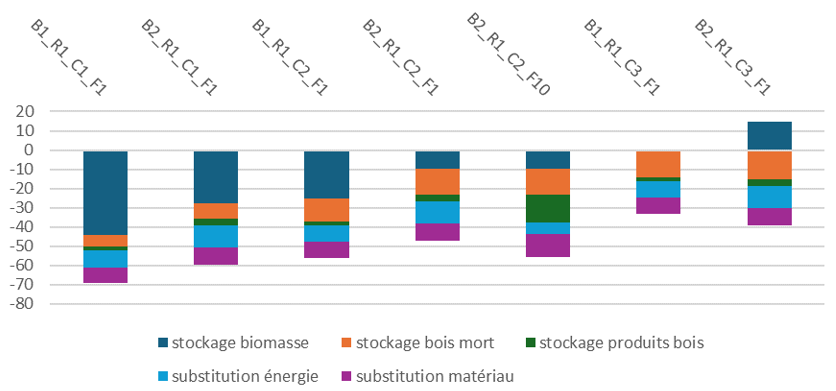
Ce graphique décompose le bilan carbone du secteur forêt-bois en différents compartiments pour plusieurs scénarios de l’étude IGN-FCBA parue en 2024.
This graph breaks down the carbon balance of the forest-wood sector into different components across several scenarios from the IGN–FCBA study published in 2024.
Lecture :
- Scenario C1 assumes the current climate crisis is temporary; however, the sectoral carbon balance deteriorates if it is repeated (C2) or becomes permanent (C3).
- An increase in timber harvests (B2, 63 Mm³/year) increases the downstream contribution of the value chain to the carbon balance (purple and light blue segments), compared with a continuation of current volumes (B1, 53 Mm³/year).
- Optimising wood uses (F10 – sawlogs used in construction, industrial wood used for panels rather than energy, maximised recycling and reuse) significantly improves the carbon balance, particularly through carbon storage and material substitution effects.
Source: authors, based on IGN and FCBA.
Foresight studies suggest the existence of a threshold beyond which increases in timber harvests become more problematic. First, the highest harvest levels considered in these studies (75 to 90 Mm³/year) appear difficult to achieve given land ownership fragmentation, accessibility constraints, insufficient forest management, and limits in industrial processing capacity. Second, such trajectories could increase the risk of forest capital depletion, particularly in the event of severe climate impacts, and could also degrade ecosystems (soils, water), biodiversity, and relationships between the sector and society, according to some authors.
Conversely, extensification scenarios described in several studies—based on stable or declining harvest levels (40–50 Mm³/year or less)—would allow the sectoral carbon balance to be maintained or even improved, including under pessimistic climate assumptions. These scenarios would also be favourable for biodiversity.9 However, they could increase exposure to risks of non-permanence of carbon stocks (which are sensitive to climate assumptions), reduce employment, and worsen the sector’s trade balance. In this context, most of the studies analysed highlight the value of pursuing a moderate increase in harvests, targeting privately owned forests that are poorly or not actively managed, in order to stimulate economic activity and renew stands. The success of such a strategy would nevertheless depend on the ability to sufficiently reorient wood uses.
Towards proactive adaptation and territorial governance
Several scenarios are based on passive or reactive adaptation to climate change. Silviculture in these cases is minimally interventionist and relies on the spontaneous adaptive capacity of forest stands, with limited investment focused mainly on crisis management and the most productive areas. These trajectories expose forests to significant climate impacts and increase territorial inequalities, with several adverse consequences: stand vulnerability, non-permanence of carbon stocks, reduced valorisation of damaged timber, and increased reliance on control or mitigation strategies.
By contrast, other scenarios involve better anticipation of climate change impacts. Forest stands are renewed using more diverse species and management approaches that are better adapted to future climatic conditions, although there is still no scientific consensus on the best way to proceed. Management in these scenarios is both proactive (preventive harvesting, etc.) and reactive, with interventions during crises in which harvested volumes are redirected towards damaged timber in order to limit material losses. Reforestation plans, which are expected to have only a limited impact on the carbon balance by 2050, could strengthen the carbon sink in the longer term.
However, the trajectories described in foresight studies face several obstacles. Mobilising privately owned forests that are poorly or not actively managed is essential. This would require removing socio-economic barriers linked to land fragmentation, promoting land consolidation, pooling of forest management, and developing forest access infrastructure. New financial support mechanisms—both public and private—could facilitate these changes, including the development of payments for ecosystem services, carbon and biodiversity finance schemes, conditionality of existing public subsidies on coordinated management, incentives for corporate sponsorship, and citizen financing or crowdfunding. Downstream in the value chain, partial reorganisation could improve the valorisation of damaged timber. This could include stronger territorial engineering capacities, greater visibility for forestry-related professions, and industrial investments in storage, transport and processing of damaged wood (panels, insulation materials, etc.). Forest health monitoring technologies are also expected to become crucial for detecting crises and prioritising interventions.
Finally, the studies underline that effective adaptation must take into account the diversity of forest regions and align national policy orientations with territorial realities. Local governance tools that promote dialogue and consultation are a key lever, and could also help reduce tensions between social groups and professionals in the forest-wood sector.10
Towards more integrated, participatory and regular foresight
French forest foresight could benefit from further development in order to overcome certain current limitations. Studies would gain from adopting a more systemic approach and better covering under-addressed issues, by combining existing models with other tools. The use of economic models (sectoral or agent-based) would help better represent market mechanisms (trade, price formation) and stakeholder decision-making (harvesting, forest management decisions), moving beyond a framework focused primarily on wood flows. Many international foresight studies already use these approaches and place greater emphasis on economic analysis.11 On the environmental side, specialised models could provide more detailed quantification of biodiversity, forest–game balance, and climatic or sanitary risks. The introduction of stochastic disturbances would make it possible to better account for climate uncertainty12, while the assessment of management impacts on landscapes13 or specific species remains an area requiring further work.14
It also appears useful to reposition models and modelling as tools to support dialogue rather than as the main producers of results. At a minimum, foresight studies could more explicitly articulate the scenarios, visions or underlying “philosophies” embedded in the parameter settings used for simulations. Future studies could rely on a set of models (without necessarily coupling them) to quantify key variables, while other dynamics could be assessed through expert judgement or described qualitatively. Scenario-building methods (morphological analysis, backcasting), which appear to be underused, would facilitate more systemic approaches and the integration of hard-to-quantify societal issues. These approaches are also well suited to stakeholder participation and are recognised for their ability to support collective dynamics beyond the foresight exercise itself.
Finally, forest foresight activity in France would benefit from better structuring. Establishing a foresight community bringing together experts, commissioning bodies and stakeholders (through seminars, training, etc.) would help foster a shared foresight identity for the forest and wood sector, as proposed by the Forestt Hub15 project funded under the PEPR Forestt programme. Such a community of forest and wood foresight practitioners already exists, for example in Finland, where several recognised academics produce foresight studies covering both upstream forestry and downstream industrial sectors.16 In addition, conducting regular foresight exercises supporting public action, modelled on the IGN–FCBA (2024) study, could be integrated into a multi-year cycle similar to that of the US Forest Service. Since 1974, this service has published, every five to ten years, a report assessing American natural resources, their trends and possible futures, including forests. These studies are both scientifically disseminated (reports, articles) and used to inform Congressional decision-making. Such a regular framework would improve visibility and coordination of timelines, provided a permanent team is in place. In France, similar working environments and communities remain to be developed or consolidated.
Conclusion
The foresight studies analysed outline contrasting trajectories for the forest-wood sector but converge on several key findings. They show that, in the short to medium term, it is possible to combine the maintenance of a carbon sink with a moderate increase in timber harvests, provided that harvesting remains limited and is accompanied by an optimisation of wood uses. However, current climate targets appear optimistic and may not be achieved if the impacts of climate change worsen, thereby shifting decarbonisation efforts onto other sectors of the economy. The studies also highlight that effective adaptation should be proactive, targeted and territorially differentiated. Finally, the foresight exercises reveal the need to remove several structural constraints in the forest sector, including land fragmentation, limited capacity to valorise damaged timber, and the sector’s public image and attractiveness of its professions.
In this perspective, the development of more integrated foresight approaches—bringing together economics, ecology and social sciences, and addressing still underexplored core issues (such as forest–game balance, etc.)—appears to be a major challenge. Beyond producing quantitative outputs, foresight could become a genuine tool for consultation and planning, capable of informing multiple trade-offs within future cycles of national strategies and forest policy more broadly.
Éric Tromeur, Alexandre Kalvelage17
Haut-commissariat à la stratégie et au plan
Miguel Rivière
Centre for Studies and Strategic Foresight
Notes de bas de page
1 - For instance, Hurmerkoski E., Sjolie H., 2018, « Comparing forest sector modelling and qualitative foresight analysis: Cases on wood products industry », Journal of Forest Economics.
2 - For instance, Donadieu de Lavit P., Leridon N., 2019, Étude prospective : Évolution de la demande finale du bois dans la construction, la rénovation et l’aménagement des bâtiments, ADEME, France Bois Forêt, CODIFAB.
3 - For instance, UNECE, FAO, 2021, Forest Sector Outlook Study 2020-2040.
4 - Secrétariat général à la planification écologique, 2023, La planification écologique pour la forêt : principaux enjeux et leviers.
5 - CGAAER, IGEDD, IGF, 2024, Mise en gestion durable de la forêt française privée.
6 - Cour des comptes, 2020, La structuration de la filière forêt-bois, ses performances économiques et environnementales.
7 - Abildtrup J., Garcia S., 2020, Les usages récréatifs des forêts métropolitaines, La Documentation française.
8 - For more details, refer to Rivière M., 2024, Modélisation prospective et action publique dans le secteur forêt bois, CEP, Analyse n° 204.
9 - Arambourou H., 2023, Vers une planification de la filière forêt-bois, La note d’analyse de France Stratégie, n° 124.
10 - For example, Regional Forest and Wood Programmes adapt the national objectives of the National Forest and Wood Programme (PNFB) at regional level. They are developed in consultation with local stakeholders. Another example is the Territorial Forest Charters (CFT), which are territorial planning and local development tools provided for under the Forestry Code. These voluntary instruments make it possible to coordinate the management of forest areas.
11 - For instance, foresights carried out by the US Forest Service of the United Nations.
12 - For example, the Firelihood fire activity model developed by INRAE enables this, cf. Pimont F. et al., 2023, Projections des effets du changement climatique sur l’activité des feux de forêt au XXIe siècle. Rapport final, INRAE.
13 - Landscape models can assess the impacts of management on certain characteristics of forest habitats that are important for biodiversity, cf. Repo A., et al., 2024, « Contrasting forest management strategies: Impacts on biodiversity and ecosystem services under changing climate and disturbance regimes », Journal of Environmental Management.
14 - Ecological economic models can link agricultural practices to bird abundance, for example Cocco V., Kervinio Y., Mouysset L., 2023, « Relaxing the production-conservation trade-off: Biodiversity spillover in the bioeconomic performance of ecological networks », Ecological Economics.
15 - GIP ECOFOR, 2024, Les échos D’ECOFOR, Numéro spécial : FORESTT-HUB.
16 - See works by Anne Toppinen and Elias Hurmekoski, for instance, from the University of Helsinki.
17 - At the moment this work was carried out.
Voir aussi
La filière forêt-bois face aux enjeux climatiques, sanitaires et sociétaux
01 avril 2026Filière bois
Entreprises de travaux forestiers : quels profils à l'avenir ?
25 janvier 2022Enseignement & recherche
La vulnérabilité des forêts aux perturbations naturelles
07 novembre 2025Filière bois
Construire en bois : potentialités environnementales et économiques
31 mars 2025Filière bois

Modélisation prospective et action publique dans le secteur forêt‑bois - Analyse n°204
11 juillet 2024CEP | Centre d’études et de prospective