Food security: ambitions, paradoxes and strategies of the Gulf countries
Partager la page
This Analysis note presents in four pages the essential elements of reflections on a topical subject within the fields of intervention of the Ministry of Agriculture, Agrifood and Food Sovereignty. Depending on the issue, they favour a foresight, strategic or evaluative approach.
Food security: ambitions, paradoxes and strategies of the Gulf countries
This Analysis examines the concept of “food security” and the challenges of sourcing and supplying agrifood commodities. By focusing on the Arabian Peninsula, it highlights the distinctive strategies of countries facing severe environmental limitations but equipped with considerable investment power and far-reaching ambitions. While diversifying sources of supply is a priority in the Gulf, establishing strategic stocks and seeking self‑sufficiency for targeted agricultural products are also major objectives of governments. Gulf states are intensifying domestic investment initiatives to position themselves as pilot sites and test hubs for future agrifood systems, while expanding their international investment portfolios to enhance their global influence.
Introduction
With less than 1% of arable land, the United Arab Emirates (UAE) aim to rank first in the Global Food Security Index (GFSI) by 2050. This objective underscores the multidimensional nature of food security, which extends well beyond the sole consideration of local production capacities. It also reveals the new position and role that the countries of the Gulf Cooperation Council (GCC)1 – Saudi Arabia, UAE, Qatar, Kuwait, Bahrain, Oman – seek to occupy on the global agri‑food stage. This ambition translates into massive investments in innovation, offshore agricultural production, logistics or “imported talents” to build the future food systems. Despite severe environmental constraints, these countries draw on their financial capacity and strong political commitment to reduce their import dependence and mitigate geopolitical vulnerabilities, illustrated by the Strait of Hormuz chokepoint, through which 80 to 100 percent of the wheat destined for Qatar, Kuwait, and Bahrain transits.
Taking the Arabian Peninsula as a case study, this note explores the concept of “food security” and its contemporary challenges. By setting aside the controversies and debates over the differences between ‘food security’ and ‘food sovereignty’2, it highlights both the complexity and concrete realities of supplying food within a specific regional context.
The first section examines the definition of food security and its assessment criteria, as well as their implications for the Gulf countries. The next section details their national strategies and the initiatives deployed to manage supply risks and fulfil their ambitions. The document ends with two forward-looking scenarios to 2050.
From the conceptual framework of food security to its application in the Gulf
A multidimensional and systemic approach
The concept of food security has progressively evolved and expanded over recent decades. While the first World Food Conference in 1974 focused primarily on increasing agricultural production, the 1996 World Food Summit redefined food security around four pillars - availability, accessibility, utilization and stability - highlighting growing concern for the physical, economic and social conditions shaping food systems. In 2020, the High-Level Panel of Experts on Food Security and Nutrition (HLPE) added two further dimensions: agency, which foregrounds individuals’ capacity to make food-related choices, and sustainability, which anchors food security in the long term. These six dimensions (Figure 1) are now widely adopted by international organizations and disseminated among food-system stakeholders.
Figure 1 – The six dimensions of food security according to international institutions
| Dimension | Description |
|---|---|
| Availability | Sufficient quantity of food produced or imported on a given territory → Ensure that the quantity of food meets needs through local production, trade or storage. |
| Accessibility | Capacity of individuals to access food → Ensure physical, economic and social access to foodstuffs. |
| Utilization | Nutritional quality, food safety, knowledge and dietary practices → Ensure satisfactory absorption and optimum use of nutrients. |
| Stability | Regular and reliable access to food over time → Ensure continuity of access to sufficient and nutritious food, independently of crises and fluctuations. |
| Agency | Capacity of individuals and communities to freely choose their food → Consider individual choices and cultural preferences while ensuring people’s active participation in food systems. |
| Sustainability | Meeting current food needs without compromising those of future generations → Ensure the long‑term regeneration of natural, social and economic systems. |
The evolution of this definition reflects the transformation of political agendas in line with crises and emergencies, as well as new societal expectations. It also illustrates the complex and multi‑dimensional nature of the issue. For example, accessibility encompasses physical aspects (e.g. logistics performance, marketing networks), economic aspects (e.g. commodity prices, oligopolistic or competitive nature of markets) and social aspects (e.g. age, gender). These interrelated dimensions necessitate a systemic and dynamic approach grounded in a diversity of solutions, rather than reliance on any single response. Despite this complexity, composite indices have been developed to enable cross-country comparisons, with the most comprehensive example being the Global Food Security Index (GFSI), published by The Economist Intelligence Unit. The GFSI evaluates 113 countries according to 59 criteria covering the dimensions of accessibility, availability, quality and sustainability/adaptation3.
Limits and paradoxes of food security in the Gulf region
The Arabian Peninsula is marked by arid to hyper-arid climates, with extremely limited land and freshwater resources increasingly strained by expanding residential, agricultural, industrial, and tourism demands. The region is also experiencing significant demographic growth: in 2024, the six GCC countries had roughly 60 million inhabitants, a number projected to rise to 83.5 million by 2050 (+39%). Each of these countries is already characterized by one of the highest water scarcity indexes on the planet4. In the Abu Dhabi emirate, groundwater withdrawal exceeds natural recharge by a factor of 25, and the water table drops by 1 to m per year5. Salinisation is also severely degrading water quality. Geopolitical and geo-economic factors further exacerbate these issues (Figure 2): maritime choke points, regional instability, and reliance on global markets, among others.
Figure 2 – The Gulf countries in their regional environment
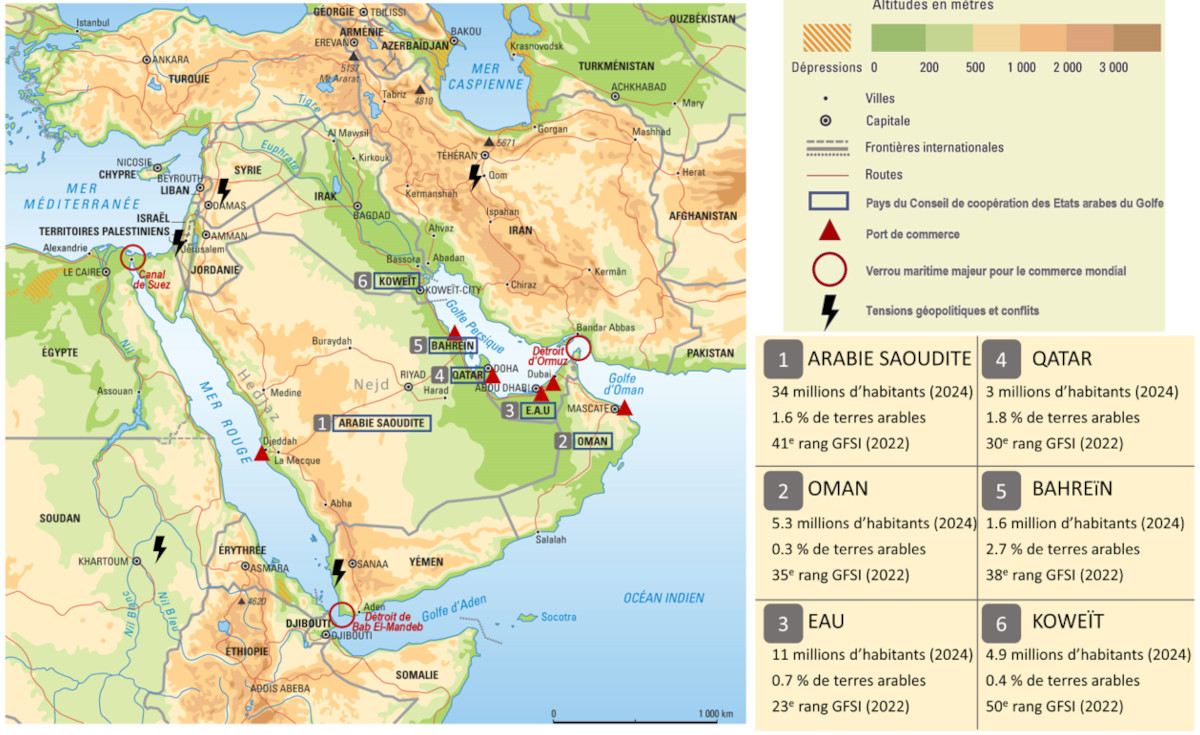
Cette carte centrée sur la péninsule Arabique localise les six pays du Conseil de coopération des États arabes du Golfe, leurs principales infrastructures portuaires, les verrous maritimes et les espaces de tensions à l’échelle régionale. Un tableau indique, pour chaque pays, la population, la part de terres arables et le rang dans le classement de l’indice mondial de sécurité alimentaire (GFSI).
This map centred on the Arabian Peninsula shows the six Gulf Cooperation Council countries along with their principal port infrastructures, maritime choke points and regional tension zones. A table details each country’s population, share of arable land, and ranking in the Global Food Security Index (GFSI).
Source: Sciences‑Po cartography workshop; author
Despite these constraints, the GCC countries hold relatively strong positions in the 2022 GFSI rankings (Figure 2), all ranking within the top half and some even within the first third. This highlights the paradox of countries with limited or negligible agriculture6 achieving relatively high levels of food security. By 2022, their share of arable land remained very low - from 0.3% in Oman to 2.7% in Bahrain7 -, while agriculture and fishing generated only 0.3% (Qatar) to 2.6% (Oman) of national GDP8. Until recently, the region’s landscapes and agricultural activities were mostly dominated by pastoral livestock (small ruminants and camelids) and the presence of scattered oases. The 1973 oil shock and the American threat of a food embargo pushed agri-food matters onto the regional agenda, leading to the introduction of the first agricultural policies at the national scale. Saudi Arabia, for instance, pursued wheat self-sufficiency, achieving it in 1984 through substantial subsidies and intensive groundwater extraction. These costs eventually compelled the country to rethink its model and sharply scale back cereal production in the 1990s.
Feeding 6 million people in the Gulf
In 2024, imports accounted for 85% of total food consumption in the GCC, including 90% of cereals, 100% of rice and 60% of meat. Import dependency is also very high for agricultural inputs. Fodder, critical for the mega‑farms in the region, is a major source of vulnerability for the local dairy sector. Diversification of supplying countries is thus a crucial issue, as 60% of the fodder (especially alfalfa) imported by Saudi Arabia and 45% by Qatar are sourced in the United States.
International maritime routes and major regional ports are of vital importance for supplying food to the population. In Saudi Arabia, more than 80% of food imports are transported by sea to the ports of Jeddah (Red Sea) and Damman (Persian Gulf). While Brazilian and Argentine maize supplies local livestock farms, wheat is imported from countries around the Black Sea (notably Russia and Romania). Rice, widely consumed by people of Asian origin — who make up the majority of foreign residents — comes mainly from India. In addition, land and air routes are used to transport perishable products (Jordanian vegetables transported by road) and high value‑added products (soft fruits imported by air from the United States).
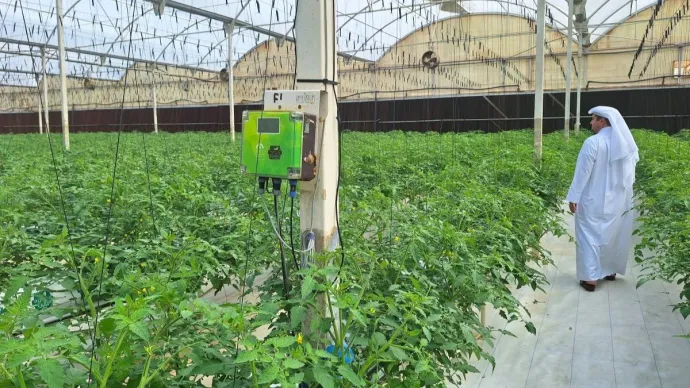
Local production, fostered by governments in the last decades, remains a major challenge. While it is limited to a few seasonal crops (vegetables from November to April) and strategic animal products (milk, eggs, poultry, aquaculture products), the aim is to increase volumes and extend production seasons through the use of technological solutions (air‑conditioned greenhouses, precision irrigation).
Regarding food habits in the Gulf, they are characterized by their significant diversity, reflecting societies shaped by migrations (with only 10% nationals in Qatar and the UAE). In a context of fast economic growth, widespread urbanisation and tourist development, new consumption patterns are emerging and spreading, revealing very heterogeneous food preferences and purchasing power. Fine dining Michelin starred restaurants coexist with international fast‑food chains, which depend on numerous home delivery drivers with very precarious status. At the bottom of the social pyramid, construction workers are fed mainly on cheap imported staples provided by their employers.
Strategic visions and agri‑food activism of the Gulf countries
Food security: navigating uncertainty and strategic dilemmas
Food security has become a strategic priority since the 2007‑2008 financial crisis and the shocks of the last decade. These have particularly affected the Arabian Peninsula: geopolitical conflicts and tensions (blockade against Qatar in 2017‑2021, war in Yemen and attacks in the Red Sea, war in Ukraine, war in Sudan and threats to investments in the country); disruptions to international trade and export restrictions (e.g. Indian rice from 2022 to 2024); extreme weather events (e.g. flash floods, sandstorms). The increased “politicization” of food in the Gulf has been accompanied by the establishment of new bodies and organizations (e.g. the Ministry of Food Security in the UAE, the Department of Food Security in Qatar).
The need to ensure food security, water security, and national security simultaneously creates significant dilemmas for policymakers. The dairy sector offers a clear illustration of this tension: is self-sufficiency the path to follow, as seen in Qatar’s decision in 2018 to set upBaladna9, a national flagship company that now covers 100% of domestic fresh-milk demand and is exporting its model (Algeria); or should milk imports be prioritized to preserve water resources, reduce energy consumption and reduce risks related to feed supply? Such dilemmas - and the political compromises they require - inform food-security strategies across the region.
Strategic foresight to 2030, 2040 and 2050
Food security features prominently in the Gulf countries’ planning documents (e.g. Vision 2030 of Saudi Arabia) and is at the core of dedicated national strategies. Established with the support of large international consultancy firms, these food security strategies are based on four main pillars: ensuring a minimum level of local production; building up stocks; diversifying import sources; investing internationally to secure supplies.
Local production efforts prioritize a narrow group of crops, selected on the basis of consumption levels and on agronomic and technological capacities at hand. Self‑sufficiency targets have thus been set for a selection of plant and animal products (Figur 3). For instance, Saudi Arabia achieves self-sufficiency levels exceeding 100% for certain products, allowing for exportation of the surplus. In contrast, Qatar bans - or allows only minimal - agricultural exports, unwilling to “virtually export” its scarce water resources. The management of groundwater or desalinated water is indeed essential to ensure water security. For example, Saudi agriculture consumes 67% of the country’s freshwater: 38% go to date palms (which consume a lot) and a third to cereals and fodder, the production of which is subject to increased regulation.
Figure 3 – Self‑sufficiency rates (current and projected) for a selection of agricultural products in Saudi Arabia and Qatar
| Products | Saudi Arabia | Qatar | |||
|---|---|---|---|---|---|
|
2023 |
2030 |
2022 |
2030 |
||
| Milk & dairy products | 129% | 150% | 100% (milk) | 100% | |
| Poultry (fresh meat) | 71% | 100% | 98% | 100% | |
| Red meat (fresh meat: beef, sheep, goat) |
61% | 100% | 19% | 30% | |
| Eggs | 100% | 100% | 25% | 70% | |
|
Cucumbers |
102% | – | 70% |
40% |
55% |
|
Tomatoes |
76% |
100% |
34% |
||
|
Eggplants |
107% |
– |
57% |
||
|
Peppers |
83% |
– |
19% |
||
|
Zucchini |
100% |
– |
76% |
||
|
Dates |
119% |
150% |
Not alvailable | – | |
|
Shrimps |
147% |
Production |
No production | – | |
Note: the food self‑sufficiency rate (share of national production in total food consumption) is calculated as follows: Local production / (Local productio + Imports – Exports) × 100.
Source : Saudi General authority for statistics, 2023;
Saudi Arabia national agriculture strategy, 2020; Qatar Food Security Strategy 2030, 2025
Storage constitutes the second pillar of the Gulf’s food security strategies. Large projects aimed at building silos, warehouses and drinking‑water reservoirs have been launched since the 2010s. Stocks of strategic inputs (fertilizers, plant protection products, vaccines) are also being built up. At the same time, early warning systems are established to anticipate shortages and optimize flows of commodities and supplies. However, the implementation of these projects across the GCC remains uneven, with the UAE leading the way and Saudi Arabia working to catch up.
Diversification of supplies and trade partners is the third pillar of national strategies. For example, Qatar’s food security strategy towards 2030 sets a target of three to five trading partners for each essential imported commodity, on the one hand, and limits the maximum share of imports coming from a single country (35 to 55%, depending on the products), on the other hand. In 2023, over 70% of the tomatoes consumed in Qatar were imported from Iran, highlighting a strong dependence and the urgency of diversifying supply sources. Qatar supports this diversification effort through bilateral agreements and international investments, which form the fourth and final pillar of the Gulf’s food security strategies.
Financial power and ability to project internationally
Gulf states’ capacity to ensure food provision and security is heavily grounded in their financial resources, which continue to be predominantly funded by hydrocarbons, accounting for 55% of public revenues in the UAE and up to 90% in Kuwait. Sovereign wealth funds, owned by the state and financed by national economic surpluses (e.g. Public Investment Fund (PIF) in Saudi Arabia; Qatar Investment Authority), are the key instruments of agri‑food strategies. They are increasingly investing in agricultural assets and overseas production around the globe. In Saudi Arabia, the PIF has invested in powerful agribusiness firms via the Saudi Agricultural and Livestock Investment Company (SALIC), established in 2009. SALIC holds 80% of the capital of Olam (grains, Singapore), 33% of Minerva (beef, Brazil), 11% of BRF (poultry, Brazil) and 12.6% of MHP (poultry, Ukraine). SALIC also invests in Saudi public companies, including Almarai, which operates the largest dairy farm on the planet (more than 9 000 cows). As for the UAE, the Emirati sovereign fund ADQ acquired 45% of the capital of the trader Louis Dreyfus in 2020.
To mitigate their supply vulnerabilities, Gulf countries aim at controlling every stage of food value chains. Public and semi‑public investors, supported by the private sector, are therefore turning to offshore agricultural production in countries with abundant water and land10. For instance, the UAE cultivate 960 000 ha of land abroad, of which 40% are operated by companies wholly or partly owned by the sovereign wealth fund ADQ (Figure 4).
Figure 4 – Offshore production of two big companies controlled by the Emirati fund ADQ
|
Country |
Cultivated areas (ha) |
Crops |
|---|---|---|
| Al Dahra : 360 939 ha (total cultivated area) | ||
|
Egypt |
260 787 |
Cereals, alfalfa, potatoes, onions, dates, mangoes, citrus fruit, pomegranates |
|
Romania |
54 633 |
Data not available |
|
Serbia |
18 461 |
Fodder, dairy products, apples |
|
Spain |
10 522 |
Fodder |
|
United States |
12 141 |
Alfalfa, onion, garlic |
|
Others (Morocco, Namibia, UAE) |
4 395 |
Olives, grapes, dates, wheat, dairy products |
| Unifrutti International Holdings : 24 600 ha (total cultivated area) | ||
|
Chili |
11 450 |
Apples, grapes, pears, cherries, peaches, blueberries |
|
Italy |
1 700 |
Citrus fruit, pears, peaches, grapes |
|
Peru |
4 200 |
Grapes, cherries, peaches, apples, blueberries |
|
Philippines |
1 700 |
Bananas |
|
South Africa |
5 000 |
Citrus fruit, grapes |
|
Others (Argentina, Ecuador, Spain) |
550 |
Vegetables, lemons, grapes |
Source: GRAIN, 2024
Gulf monarchies are also making substantial investments in logistics chains, with growing attention to the African and Asian coastlines11. Dubai Ports World and Abu Dhabi Ports Group, among the world’s largest port operators, are building a global network of agri‑food terminals. Combined with free zones and linked to inland agricultural areas in Africa or Asia, this network of terminals will be connected to the major hub of Jebel Ali (port of Dubai).

Gulf ambitions: pursuing leadership in agri-innovation and global influence
To strengthen their presence on the global stage, the GCC countries undertake a wide range of initiatives to broaden their agri-food diplomatic and scientific influence. They host a growing number of international fairs which contribute to their agri‑diplomatic influence (e.g. Gulfood in Dubai and Saudi agriculture in Riyadh). They are also multiplying initiatives in favour of food security, such as the Declaration on sustainable agriculture, resilient food systems and climate action, initiated by the UAE and signed by 13 countries in Dubai (COP28, 2023). The region also hosts think tanks, foundations and research centres dedicated to the future of our food systems (e.g. the International Center for Biosaline Agriculture in the UAE; Earthna Center for a Sustainable Future in Qatar).
In terms of innovation, the UAE and Saudi Arabia are competing to attract researchers, experts and innovative entrepreneurs. They are seeking to establish themselves as hubs for agritech and foodtech innovations, able to address the major challenges of climate change. In a sense, the Arabian Peninsula’s harsh environmental conditions become an asset, turning these arid territories into an ideal testing ground. The Saudi university KAUST (King Abdullah University of Science and Technology) hosts, for example, the Centre of Excellence for Sustainable Food Security, where studies are conducted on genomic editing of wheat and the robotisation of date palm cultivation.
The Gulf’s 2050 trajectory in the global agri-food system: a two-scenario analysis
The following scenarios imagine the future place of the Gulf countries on the global agri‑food stage and their trajectories to 2050. Deliberately contrasted, these foresight exercises do not claim to predict the future or prescribe what it ought to be; rather, they are designed to stimulate reflection. They draw on scientific and grey literature, complemented by in-depth knowledge and expertise on the Middle East.
Scenario 1. GCC 2050, a leading agro‑technological union
During the 2030s, the Gulf states, overcoming their historical rivalries, enhance their cooperation, making the GCC a solid and structured political and economic union. In this new regional framework, a common food security strategy is implemented to guarantee stable and adequate food supply for the peninsula’s 8 million residents. Such an initiative relies on the effective pooling of procurement activities on international markets, sufficient storage capacities, and ambitious regional agri‑food projects. Water and energy‑intensive agricultural systems are gradually abandoned as environmental constraints increase in the region. National agrifood champions restructure their organisation, deploying their investments worldwide and replicating their models on different continents. Such players become the pillars of a transnational agri‑industrial network, managed from Riyadh, Abu Dhabi or Doha, able to integrate and connect farms, processing units and logistics corridors. At the same time, the Gulf countries consolidate their role as a hub of agri‑food innovation, becoming leaders in climate‑smart solutions. By 2050, the GCC stands out as a regional and global centre of excellence, supported by leading research institutes and international programmes co‑financed by member states.
Scenario 2. Gulf 2050: exacerbated fragilities of regional food security
Until 2030, GCC countries sustain their investments in the agri-food sector, targeting greater strategic autonomy. However, rising internal tensions hinder regional coordination, resulting in inefficient duplication of productive and logistical infrastructures and intensifying competition to attract firms, investment and skilled labour. The viability of local farms and the profitability of agro‑industrial projects are undermined by supply disruptions (in raw materials and technological components), insufficient investment and worsening climate risks, leading to increased food and technological dependence. Offshore agricultural projects encounter growing land-use conflicts in host countries, prompting the Gulf to scale back its investments from 2035 onward. Successive geopolitical and sanitary crises disrupt trade routes and flows, heightening national retrenchment and leaving Gulf countries particularly vulnerable, with increasingly erratic supply chains. By 2050, some regions of the Arabian Peninsula, no longer viable or affordable for residents, will see intensified migration and a significant population decrease.
Conclusion
The case study of the Gulf countries contributes to clarify and illustrate the range of strategies and instruments used by governments to guarantee an adequate food supply to their populations. This analysis underlines the importance of combining tools and using contextualized approaches. The specific experience of the GCC underscores the importance of risk identification and anticipation, as well as long-range and multi-scalar government planning, in guaranteeing steady and adequate food supplies.
Although public authorities are tasked with shaping policies and identifying partners, they must simultaneously - and paradoxically - acknowledge and manage some inevitable dependencies. Diversification has become the cornerstone of food security strategies within the Gulf: diversification of origins and trade routes; diversification of target countries for agri‑food investment; diversification of investment along the value chains. Although food-security levels are generally satisfactory, the Gulf countries remain highly vulnerable, leading some of them to develop foresight scenarios in anticipation of potential shocks, ranging from epizootics and assaults on desalination facilities to strait closures or sharp declines in oil and gas prices.
Delphine Acloque
Centre for studies and strategic foresight
Footnotes
1 - The Gulf Cooperation Council, which is headquartered in Riyadh (Saudi Arabia), was created in 1981. It brings together all the countries of the Arabian Peninsula, with the exception of Yemen.
2 - To deepen the understanding of food security and food sovereignty concepts and debates, different sources can be recommended and consulted : Bru M., 2022, Sécurité alimentaire, souveraineté alimentaire : tout comprendre, Fondation FARM ; Makombe G., 2024, « The food security concept: Definition, conceptual frameworks, measurement, and operationalization », Africa Development. 48, 4; Patel R., 2009, « Food sovereignty », The Journal of Peasant Studies, 36(3), pp. 663‑706.
3 - This fourth dimension, introduced in 2020, assesses the country’s vulnerability to climate change impacts, the risks linked to natural resources and adaptation policies.
4 - World Resources Institute, Aqueduct country rankings 2023, accessed on 10/10/2025.
5 - Environment Agency Abu Dhabi, 2018, Groundwater Atlas of Abu Dhabi Emirate.
6 - The expression “countries with little or no agriculture” refers to the very limited area of arable land (less than 1.5% in most GCC countries) and the tiny share of agriculture in GDP and the workforce.
7 - World Bank, 2022, Share of arable land in total national area, World Bank data 2022, accessed on 10/10/2025.
8 - World Bank, 2024, Share of value added from agriculture, forestry, and fishing in GDP, World Bank data 2024, accessed on 10/10/2025.
9 - Baladna, meaning “our country” in Arabic, underscores the close connection between national security and food security, as well as the heightened politicisation of this issue during the blockade of Qatar (2017-21).
10 - M. Brun, 2019, « Produire et se nourrir dans les monarchies du Golfe », Revue internationale des études du développement, 237 ; C. Henderson, 2020, « Land grabs reexamined: Gulf Arab agro‑commodity chains and spaces of extraction », Environment and Planning A: Economy and Space, 53(2).
11 - Grain, 2024, Des terres à la logistique : le pouvoir croissant des Émirats arabes unis dans le système alimentaire mondial, accessed on 07/23/2025.
Voir aussi
Environnement et sécurité alimentaire : le cas de la riziculture vietnamienne - Analyse n° 193
24 août 2023CEP | Centre d’études et de prospective
Financiarisation de la production agricole : une analyse des enjeux fonciers - Analyse n° 174
15 mars 2022CEP | Centre d’études et de prospective
MOND'ALIM 2030
01 mars 2019Enseignement & recherche
Les politiques agricoles à travers le monde
18 juillet 2024Production & filières